Silicon Valley Can Befoul Anything, Even DeathOn our tech sector's insistence on perverting all that it touches.
Last week, a former Disney star (Calum Worthy) took to Twitter to reveal his new app: 2wai, which claimed it would use artificial intelligence and a three-minute video to digitally clone a user’s loved ones. To promote this new grift—uhh, I mean enterprise—Worthy shared a short video online about what life with 2wai might be like, captioned “What if the loved ones we’ve lost could be part of our future.” The video begins with “Baby Charlie” floating on the screen. A pregnant woman is talking to her elderly mother, showing her bump and sharing that her baby has been kicking a lot lately. The older woman gives her daughter some advice, “Put your hand on your tummy and hum to him. You used to love that.” And so the expecting mother does; “It feels like he’s dancing in there.” We cut to “10 months later” and Charlie is a big ass baby now. His mother sits down and brings him close to her phone, “Mom, would you tell Charlie that bedtime story you used to always tell me?” Her elderly mother is on the phone now and she hasn’t aged a day. As she tells Charlie the bedtime story, her daughter begins to cry. Now it’s “10 years later” and we see Charlie again, a kid walking home from school holding a featureless smartphone (NO COPYRIGHT INFRINGED UPON) and video chatting his elderly grandmother (who still hasn’t aged a day). He tries to talk to her about basketball and she interjects, “I don’t really care that much about basketball. What about...” there’s a mischievous pause, “the crush?” The boy tries to wave it off, “Stop, grandma, stop talking,” he repeats over her teasing plea to “Just tell me one thing!” We cut to “30 years old” and Charlie is holding up a picture of an ultrasound to his Featureless Smartphone. “Look who’s going to be a great grandmother.” Some things never change. His grandmother hasn’t aged a day. His wife is complaining that the baby has been kicking a lot lately. “Tell her to put her hand on her belly and hum to him. You loved that,” Granny tells Charlie. “You would have loved this moment,” Charlie glumly replies. “You can call anytime.” Now it’s “Before Charlie” and the elderly woman is being filmed by her daughter (Charlie’s mother) for a three minute video. They’re laughing, cracking jokes, and the screen cuts to white: “With 2wai, three minutes can last a lifetime.” When I first saw this ad, my impulse was to write something about it because I felt there was no shortage of angles to cover. Where to start? The silent admission in the ad that this digital avatar is not your loved one, even as the entire video pretends otherwise. Or the similarity here to an episode from Season 2 of Black Mirror (”Be Right Back”)—a woman’s boyfriend dies in a car accident and, after she learns she’s pregnant, is brought back with a “digital clone” from his social media posts that communicates with her through texts, then phone calls, then IRL after she embodies it in a synthetic body. We could talk about the fact that I’m struggling to think of a single science fiction story where a good response to grief might feature digitally cloning your lost loved one and keeping them trapped in your phone for decades as your life moves on. Why must everything, even death, be subjected to the bureaucratic rationality that has swallowed the horizon of what’s possible with computation? Or we could contextualize this startup with Worthy’s past comments about what inspired this project—not a desire for connection with loved ones but a desire to capitalize on parasocial relationships:
But all of that is really downstream of what I’ve been interested in for years: understanding the reactionaries who’ve used twisted varieties of techno-utopian ideas to trap us in today’s death cult. We can all understand wanting to live a little longer or getting extra moments with loved ones, but tech capitalists have taken these longstanding impulses to an irrational extreme in hopes of getting more: accumulating more time to accumulate more wealth to accumulate more power over their biology, our sociality, and (one day, they hope) reality itself. As it turns out, I wrote an essay five years ago for VICE that is relevant to 2wai, but gets to the larger issue at hand: Silicon Valley’s insistence on perverting everything it touches, including death. Read it below. The Proto-Communist Plan to Resurrect Everyone Who Ever LivedIs there anything that can be done to escape the death cult we seem trapped in? One of the more radical visions for how to organize human society begins with a simple goal: let’s resurrect everyone who has ever lived. Nikolai Fedorov, a nineteenth-century librarian and Russian Orthodoxy philosopher, went so far as to call this project “the common task” of humanity, calling for the living to be rejuvenated, the dead to be resurrected, and space to be colonized specifically to house them. From the 1860s to the 1930s, Fedorov’s influence was present throughout the culture—he influenced a generation of Marxists ahead of the Russian Revolution, as well as literary writers like Leo Tolstoy and Fyodor Dostoevsky, whose novel, The Brothers Karamazov, directly engaged with Federov’s ideas about resurrection. Note: The first 18 seconds of the video feature a bright white background that flashes and pulses rapidly. 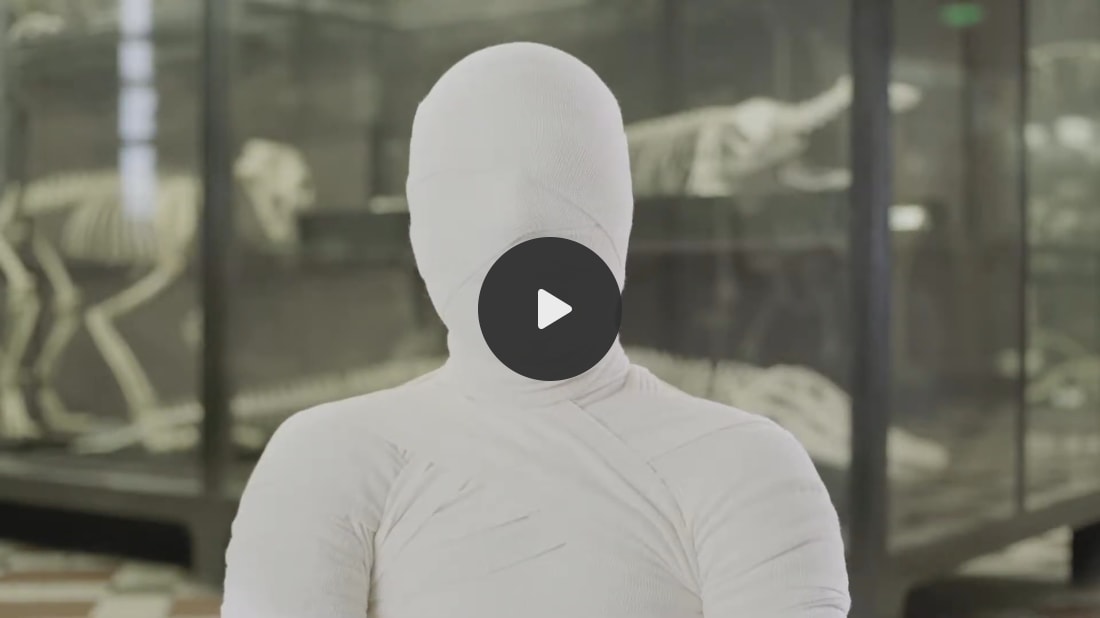 After his death, Federov’s acolytes consolidated his ideas into a single text, A Philosophy of the Common Task, and created Cosmism, the movement based on his anti-death eschatology. Federov left the technical details to those who would someday create the prerequisite technology, but this did not stop his disciples: Alexander Bogdanov—who founded the Bolsheviks with Lenin—was an early pioneer of blood transfusions in hopes of rejuvenating humanity; Konstantin Tsiolkvosky, an astrophysicist who was the progenitor of Russia’s space program, sought to colonize space to house the resurrected dead; and Alexander Chizhevsky, a biophysicist who sought to map out the effects of solar activity on Earth life and behavior, thought his research might help design the ideal society for the dead to return to. The vast majority of cosmists were, by the 1930s, either murdered or purged by Stalin, muting the influence of their ambitious project but also leaving us with an incomplete body of work about what type of society resurrection requires or will result in, and whether that would—as some cosmists believe now—bring us closer to the liberation of the species. Now, I think it is obvious that—despite what today’s transhumanists might tell you—we are in no position, now or anytime soon, to resurrect anyone let alone bring back to life the untold billions that have existed across human history and past it into the eons before civilization’s dawn. To be clear, I think cosmism is absolute madness, but I also find it fascinating. With an introduction to Cosmism and its implications, maybe we can further explore the arbitrary and calculated parts of our social and political order that prioritize capital instead of humanity, often for sinister ends. What? Who gets resurrected? And how? At its core, the Common Task calls for the subordination of all social relations, productive forces, and civilization itself to the single-minded goal of achieving immortality for the living and resurrection for the dead. Cosmists see this as a necessarily universal project for either everyone or no one at all. That constraint means that their fundamental overhaul of society must go a step further in securing a place where evil or ill-intentioned people can’t hurt anyone, but also where immortality is freely accessible for everyone. It’s hard to imagine how that world—where resources are pooled together for this project, where humans cannot hurt one another, and where immortality is free—is compatible with the accumulation and exploitation that sit at the heart of capitalism. The crisis heightened by coronavirus should make painfully clear to us all that, as J.W. Mason—an economist at CUNY—recently put it, we have “a system organized around the threat of withholding people’s subsistence,” and it “will deeply resist measures to guarantee it, even when the particular circumstances make that necessary for the survival of the system itself.” Universal immortality, already an optimistic vision, simply cannot happen in a system that relies on perpetual commodification. Take one small front of the original cosmist project: blood transfusions. In the 1920s, after being pushed out of the Bolshevik party, Bogdanov focused on experimenting with blood transfusions to create a rejuvenation process for humans (there’s little evidence they do this). He tried and failed to set up blood banks across the Soviet Union for the universal rejuvenation of the public, dying from complications of a transfusion himself. Today, young blood is offered for transfusion by industrious start-ups, largely to wealthy and eccentric clients—most notably (and allegedly) Peter Thiel. In a book of conversations on cosmism published in 2017 titled Art Without Death, the first dialogue between Anton Vidokle and Hito Steyerl, living artists and writers in Berlin, drives home this same point. Vidokle tells Steyerl that he believes “Death is capital quite literally, because everything we accumulate—food, energy, raw material, etc.—these are all products of death.” For him, it is no surprise we’re in a capitalist death cult given that he sees value as created through perpetual acts of extraction or exhaustion. Steyerl echoes these concerns in the conversation, comparing the resurrected dead to artificial general intelligences (AGIs), which oligarch billionaires warn pose an existential threat to humanity. Both groups anticipate fundamental reorganizations of human society, but capitalists diverge sharply from cosmists in that their reorganization necessitates more extraction, more exhaustion, and more death. In their conversation, Steyerl tells Vidokle:
One of the major problems of today’s transhumanist movement is that we are currently unable to equally distribute even basic life-extension technology such as nutrition, medicine, and medical care. At least initially, transhumanists’ vision of a world in which people live forever is one in which the rich live forever, using the wealth they’ve built by extracting value from the poor. Today’s transhumanism exists largely within a capitalist framework, and the country’s foremost transhumanist, Zoltan Istvan, a Libertarian candidate for president, is currently campaigning on a platform that shutdown orders intended to preserve human life during the coronavirus pandemic are overblown and are causing irrevocable damage to the capitalist economy (Istvan has in the past written extensively for Motherboard, and has also in the past advocated for the abolition of money). Cosmists were clear in explaining what resurrection would look like in their idealized version of society, even though they were thin on what the technological details would be. Some argue we must not only restructure our civilization, but our bodies so that we can acquire regenerative abilities, alter our metabolic activity so food or shelter are optional, and thus “overcome the natural, social, sexual, and other limitations of the species” as Arseny Zhilyaev puts it in a later conversation within the book. Zhilyaev also invokes Federov’s conception of a universal museum, a “radicalized, expanded, and more inclusive version of the museums we have now” as the site of resurrection. In our world, the closest example of this universal museum is the digital world “which also doubles as an enormous data collector used for anything from commerce to government surveillance.” The prospect of being resurrected because of government/corporate surveillance records or Mormon genealogy databases is “sinister” at best, but Zhilyaev’s argument—and the larger one advanced by other cosmists—is that our world is already full of and defined by absurd and oppressive institutions that are hostile to our collective interests, yet still manage to thrive. The options for our digital world’s development have been defined by advertisers, state authorities, telecom companies, deep-pocketed investors, and the like—what might it look like if we decided to focus instead on literally any other task? All this brings us to the question of where the immortal and resurrected would go. The answer, for cosmists, is space. In the cosmist vision, space colonization must happen so that we can properly honor our ethical responsibility to take care of the resurrected by housing them on museum planets. If the universal museum looks like a digital world emancipated from the demands of capital returns, then the museum planet is a space saved from the whims of our knock-off Willy Wonkas—the Elon Musks and Jeff Bezos of the world. I am not saying it is a good or fair idea to segregate resurrected dead people to museum planets in space, but this is what cosmists suggested, and it’s a quainter, more peaceful vision for space than what today’s capitalists believe we should do. For Musk, Mars and other future worlds will become colonies that require space mortgages, are used for resource extraction, or, in some cases, be used as landing spots for the rich once we have completely destroyed the Earth. Bezos, the world’s richest man, says we will have “gigantic chip factories in space” where heavy industry is kept off-planet. Beyond Earth, Bezos anticipates humanity will be contained to O’Neill cylinder space colonies. One might stop and consider the fact that while the cosmist vision calls for improving human civilization on Earth before resurrecting the dead and colonizing space, the capitalist vision sees space as the next frontier to colonize and extract stupendous returns from—trillions of dollars of resource extraction is the goal. Even in space, they cannot imagine humanity without the same growth that demands the sort of material extraction and environmental degradation already despoiling the world. Better to export it to another place (another country, planet, etc.) than fix the underlying system. Why? Ostensibly, the “why” behind cosmism is a belief that we have an ethical responsibility to resurrect the dead, much like we have one to care for the sick or infirm. At a deeper level, however, cosmists not only see noncapitalist abundance as a virtue in of itself, but believe the process of realizing it would offer chances to challenge deep-seated assumptions about humanity that might aid political and cultural forms hostile to the better future cosmists seek. Vidokle tells Steyerl in their conversation that he sees the path towards resurrection involving expanding the rights of the dead in ways that undermine certain political and cultural forms, In another part of their conversation, Steyerl suggests that failing to pursue the cosmist project might cede ground to the right-wing accelerationism already killing millions: There is another aspect to this: the maintenance and reproduction of life is of course a very gendered technology—and control of this is on a social battleground. Reactionaries try to grab control over life’s production and reproduction by any means: religious, economic, legal, and scientific. This affects women’s rights on the one hand, and, on the other, it spawns fantasies of reproduction wrested from female control: in labs, via genetic engineering, etc. In other words, the failure to imagine and pursue some alternative to this oligarchic project has real-world consequences that not only kill human beings, but undermine the collective agency of the majority of humanity. In order for this narrow minority to rejuvenate and resurrect themselves in a way that preserves their own privilege and power, they will have to sharply curtail the rights and agency of almost every other human being in every other sphere of society. Elena Shaposhnikova, another artist who appears later in the book, wonders whether the end of death—or the arrival of a project promising to abolish it—might help us better imagine and pursue lives beyond capitalism: “It seems to me that most of us tend to sublimate our current life conditions and all its problems, tragedies, and inequalities, and project this into future scenarios,” she said. “So while it’s easy to imagine and represent life in a society without money and with intergalactic travel, the plot invariably defaults to essentialist conflicts of power, heroism, betrayal, revenge, or something along these lines.” In a conversation with Shaposhnikova, Zhilyaev offers that cosmism might help fight the general fear of socialism as he understands it: According to Marx, or even Lenin, socialism as a goal is associated with something else—with opportunities of unlimited plurality and playful creativity, wider than those offered by capitalism. … the universal museum producing eternal life and resurrection for all as the last necessary step for establishing social justice. In the conversations that this book, cosmism emerges not simply as an ambition to resurrect the dead but to create, for the first time in human history, a civilization committed to egalitarianism and justice. So committed, in fact, that no part of the human experience—including death—would escape the frenzied wake of our restructuring. It’s a nice thought, and something worth thinking about. Ours is not that world but in fact, one that is committed, above all else, to capital accumulation. There will be no resurrection for the dead—there isn’t even healthcare for most of the living, after all. Even in the Citadel of Capital, the heart of the World Empire, the belly of the beast, the richest country in human history, most are expected to fend for themselves as massive wealth transfers drain the public treasuries that might’ve funded some measure of protection from the pandemic, the economic meltdown, and every disaster lurking just out of sight. And yet, for all our plumage, our death cult still holds true to Adam Smith’s observation in The Wealth of Nations: “All for ourselves, and nothing for other people, seems, in every age of the world, to have been the vile maxim of the masters of mankind.” You're currently a free subscriber to The Tech Bubble. For the full experience, upgrade your subscription.
|