The Truth About Steve DeAngelo, the One Acre Cap, and Prop. 64Here’s what the psychedelic movement can learn from Steve DeAngelo’s journey.
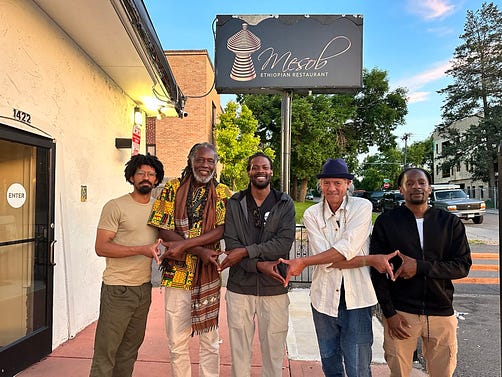
Note from Reggie (AKA HNIC): I decided we needed to write this piece because every time I share a photo of myself with Steve DeAngelo-like the one below-my DMs light up with people from the cannabis world telling me he “ruined the weed game” or personally engineered the one-acre-cap disaster that crushed small farmers. I’ve known Steve as a friendly neighbor in Oakland who I’ve admired for more than a decade and a half, but I refuse to let friendship, admiration, or backlash override the facts-or my responsibility to protect and defend my community from vultures and bloodsuckers. As he becomes more active in the psychedelics community -and as we come up on the 10-year anniversary of the passage of Proposition 64 in California - it’s incumbent on us to separate truth from rumor and actually dig into what happened with Prop. 64, the one-acre cap, and the decisions that shaped California cannabis. So we commissioned an independent investigation, spoke directly with Steve and his critics, and tried to bring daylight to a conversation most people prefer to have only behind closed doors.
The Truth About Steve DeAngelo, the One Acre Cap, and Prop. 64By Jack Gorsline Steve DeAngelo is, by nature and necessity, a political operator. He speaks in the polished, rhythmic cadence of a man who has spent decades shaping narratives, rocking his signature fedora like an unofficial campaign badge for his personal brand. Yet, for a man who has picked up the nickname “Father of the Legal Cannabis Industry,” his paternity is hotly contested. Ask 10 people from the Bay to the Emerald Triangle about DeAngelo’s role in Proposition 64 (Prop. 64) – the 2016 ballot measure that legalized adult-use cannabis in California – and you are bound to get eight or nine conflicting answers, ranging from a pragmatic savior who ended prohibition to a corporate collaborator who helped dismantle the state’s legacy culture. His polarized legacy is no longer just a matter of cannabis history, however; it is becoming a central tension in the future of psychedelic advocacy. Over the last two years of reporting on the politics of psychedelic policy reform, I’ve watched a familiar architecture reassemble itself: The same major philanthropic funders and political strategists – especially the powerful New Approach PAC – that bankrolled the cannabis legalization wave throughout the U.S. are now the primary architects of the political arm of the psychedelic renaissance. As DeAngelo re-emerges as a vocal advocate in this new “psychedelic ecosystem,” the overlap in philanthropic influence and political strategy is impossible to ignore. Is the movement inheriting the wisdom of the cannabis pioneers, or merely inheriting their baggage? To understand where the psychedelic movement is heading, we have to look back at 2016 to determine if the hard lessons of the Green Rush can spare it from the same fatal missteps, or if we’re watching a familiar story march toward the same tragic ending. California’s Prop. 64: RevisitedFor DeAngelo, the story of California’s adult-use legalization begins with a sense of betrayed trust. As he remembers it, the initial plan allegedly revolved around the “Unity Draft,” a collaborative legislative framework for recreational cannabis legalization that activists believed would protect legacy operators including a provision that would limit commercial cultivation sites to one acre, thus preventing license-stacking mega-farms for 5 years following recreational legalization, allowing small farms to lay a sustainable financial foundation to survive a future landscape of large-scale competitors. “The messaging that we had been getting was that Sean Parker had agreed to contribute $25 million to the initiative campaign and that that campaign was going to be headed up by the Drug Policy Alliance,” DeAngelo told us, noting that the cannabis activists in the room were comfortable with the DPA’s leadership. DeAngelo claims that comfort evaporated when the funding from Sean Parker — the co-founder of Napster and the first president of Facebook — allegedly bypassed the DPA entirely. “Long story short… the political hacks in Sacramento got ahold of our Unity Draft, and they changed it very substantially,” DeAngelo claimed, specifically citing the involvement of political consultant Gale Kaufman. “They had a very different agenda.” Despite recognizing the flaws in the revised language that would become Prop. 64, DeAngelo claims that he and his advocacy peers faced a grim calculus. They feared that rejecting the initiative would signal to the world that even California wasn’t ready to end prohibition, potentially inviting a resumption of federal raids. “The alternative of not passing it… would have really set back the movement a long way,” he said. The “head start” they hoped Prop. 64 would provide for legacy operators proved illusory, however. Regulatory hurdles decimated the “homesteading culture” of the Emerald Triangle. “Of our 500 small and independent growers, only 10 of them had state cannabis licenses on January 1st, 2018,” DeAngelo said. The regulatory squeeze hit close to home. A 2014 San Jose mandate requiring 100% vertical integration forced Harborside to expand rapidly into cultivation in the Salinas Valley, a region in California known for its “mega-farms.” To finance the build-out, they brought in outside capital. “We thought those investors were gonna be good partners,” DeAngelo said, “[when] in fact, they ended up really being predators,” The deal structure between DeAngelo and Harborside was unforgiving. The Harborside founders bore the production risk, and when the new farm suffered “crop failure after crop failure,” the equity claw-backs were severe. The investors gained a controlling share just as the law DeAngelo had reluctantly supported went into effect. “That’s one of the things that led me to resign as CEO of Harborside on January 1st, 2018,” DeAngelo said. It was a bitter irony: on the very day recreational cannabis became legal in California, its most visible champion had lost control of the company he built.
Longtime Strategist Lynne Lyman Sets the Record StraightLynne Lyman, the former Director for Drug Policy Action who helped steer the Prop. 64 campaign, offers a starkly different accounting of the chaotic road to adult-use cannabis legalization in California. Where Steve DeAngelo saw “political hacks” hijacking a movement to serve a different agenda, Lyman saw necessary professionalism brought in to secure a win after decades of failure. “We wanted the best of the best, and that’s who we hired,” Lyman said, defending the choice of consultant Gale Kaufman following an open bid process where every major general consultant in Sacramento applied. “I don’t really think there’s anything very fishy there.” Lyman also sought to dispel the persistent mythology regarding Sean Parker’s role. While DeAngelo recalled a promise of $25 million that never materialized, Lyman stated flatly that the figure was a rumor. Parker had committed to being an “anchor funder” – ultimately contributing between $8.5 and $8.9 million – but he “knew nothing about a Unity Draft,” according to Lyman, and was never involved in the granular policy discussions. Parker did not respond to our request for comment. Regarding that “Unity Draft,” Lyman contends there was a fundamental misunderstanding of the process and that no such framework actually existed. The “drafting tables” DeAngelo participated in were forums for industry wishlists, not legal writing sessions. “Only the lawyers actually draft language,” she noted. The real blow to legacy farmers, according to Lyman, didn’t happen in the initial drafting of Prop. 64, but during the legislative reconciliation process known as SB-94, also known as “MAUCRSA,” in 2017. Because the ballot measure was written with built-in flexibility to allow the legislature to amend the framework – a move intended to prevent the law from becoming stagnant – the door was subsequently opened for lobbying. And, thus, in the halls of Sacramento, Prop 64’s voter-approved five-year cap on commercial cannabis farming was quietly removed. “That is really what ultimately determined how the regs would work in California,” Lyman explained. She emphasized that this wasn’t a secret backroom deal where activists were locked out. “Steve and his lobbyists were all at the table for SB-94… It wasn’t a small circle at all.” While she admits she doesn’t know exactly which cannabis industry stakeholders really “sold out” to allow mega farms to start operations on January 1st, 2018, the outcome has left her deeply disillusioned with the state of drug policy. She argues the sector collapsed because “there is no longer a cannabis policy sector,” operating solely in the public’s interest, resulting in neutral advocates without a financial stake being replaced entirely by self-interested businesses. It is a dynamic she fears is repeating in the psychedelic space. “I actually don’t support legalizing psychedelic drugs at this point,” Lyman said. “I mean, in many ways, we all feel like legalization kind of ruined weed.” Her concern is that without a “public interest” policy wing funded by philanthropy rather than industry, corporate interests will always be “four, five, six steps ahead” of regulators. She fears a pharmaceutical takeover where mushrooms will become just another commodity. Despite the “disastrous” commercial outcomes of cannabis legalization, Lyman maintains respect for DeAngelo’s role in the history books. She views him as an “anchor member” of the movement who was willing to spend his own money when few others would. “Steve was one of the... bravest and most outspoken of the industry players,” Lyman said. “I often see Prop. 64 as like a relay race... Different people passed the baton and had to lead at different times.” Steve DeAngelo: Here and NowToday, DeAngelo is attempting to transcend the specific battles of California cannabis to become a stabilizing elder in the global drug policy movement. His work with the Global Psychedelic Society and support of Jamaica’s psychedelic and cannabis communities are part of a broader effort to export the lessons of the Emerald Triangle to the rest of the world. He’s also worked hard over the last 18 months to set the record straight on Prop. 64 – with not one but two articles exploring DeAngelo’s involvement in “the Prop. 64 movie,” as he puts it – being published by Forbes in 2025, nearly 8 years after the shocking removal of Prop. 64’s one-acre farming cap provisions. Curiously, only the second of those two Forbes articles remains online, as the first feature piece was quietly removed just days after publication without any formal explanation given publicly by Forbes at the time. We reached out to Forbes’ editorial staff multiple times for comment but they did not respond. When I asked DeAngelo if he had any insights into why Forbes pulled the feature, he alleged that the reporter originally assigned to interview DeAngelo conducted little, if any, follow-up reporting after they spoke. “Forbes has a sensitivity there,” DeAngelo explained, noting that, “if specific people or publications are mentioned,” he added, “then they want quotes from those folks also to be put into the article.” Currently, DeAngelo’s most ambitious project is the OnePlant Alliance, a coalition designed to solve what he describes as a “civil war” between the hemp, licensed cannabis, and legacy sectors in the U.S. “The OnePlant Alliance is an effort to end the civil war and direct all of the amazing government relations resources that have been developed… towards creating one legal cannabis market for all cannabinoids,” DeAngelo told us. The plan relies on pivoting away from the fractured regulatory landscape and toward a unified standard. He calls it a “wishful thinking” moonshot that some have told him is impossible because “people are dug in,” but DeAngelo insists it’s the only way out of the current stalemate. His urgency is fueled by what he sees happening in the psychedelic space, specifically the corporate restructuring of MAPS and its public-benefit arm, Lykos Therapeutics. For DeAngelo, the recent drama surrounding Lykos is a beat-for-beat replay of his own loss of control over Harborside. “It really closely mirrors what happened to Harborside where… we were a non-profit, we were mission-driven, and we envisioned a sharing economy,” DeAngelo said. “And that was exactly the situation with MAPS.” (Editor’s Note: According to our research and prior public reporting, a “sharing economy” was/is not a core tenet of MAPS’ organizational vision for bringing MDMA to market.) DeAngelo points to the turbulence surrounding the FDA approval process as the moment when, in his opinion, the “investor class” made its move. While the public record shows the FDA advisory committee voted overwhelmingly against the therapy, for his part, DeAngelo perceives the subsequent fallout as a calculated seizure of power by capital interests who “booted Rick [Doblin] out of that company” in response to the regulatory hurdles. (Editor’s Note: While Doblin is no longer chairman of the board of Lykos Therapeutics, which has now been rebranded as Resilient Therapeutics, public reporting earlier this year indicates Doblin spearheaded a financial revival for control of Resilient with billionaire backing.) “They brought investors in… and those investors acquired some share in the governance of the company,” DeAngelo said. “Exactly what we’ve seen operating in cannabis, we saw in the psychedelic movie [of the Lykos board takeover].” He sees the same pattern of “public companies” listing on Canadian exchanges – often with little more than a pitch deck and a prayer – creating a bubble that serves financial speculation rather than patient access. It is this cycle of “predatory” investment and mission drift that he says he is now desperate to help the psychedelic community avoid, essentially urging them to look at his scars and see their own future. “A Cautionary Tale”If DeAngelo’s advocacy for the “OnePlant Alliance” sounds urgent, it is because it is born from personal devastation. The failure of the “limited license” model he once championed as a strategic compromise isn’t just theoretical: It cost him everything. DeAngelo revealed that after the initial struggles with Prop. 64, Harborside’s Board of Directors attempted a massive expansion, borrowing $118 million to execute a “roll-up strategy” in California. He advised against it, but the company proceeded, buying up distressed assets until the debt became unmanageable. “Ultimately [they] were unable to pay the lenders… a group called Pelorus,” DeAngelo said. “That’s what led to Harborside going into receivership. And as far as we know now, the Pelorus group has taken control.” He now views California as the “canary in the coal mine,” a grim testament to what happens when activists confuse a “strategic compromise” for an “ultimate objective.” He fears the psychedelic movement is walking blindly into the same trap. His advice to the emerging “gray market” of mushroom cultivators is blunt: Do not let yourselves be regulated out of existence in exchange for a temporary sense of safety. “We’re not going to be able to stop corporate psychedelics any more than we’ve been able to stop corporate cannabis,” he said. But he insists the fight must be to maintain “community space” where medicines can be exchanged outside of a $2,000 clinical model. He argues that the “psychedelic churches” and small-scale mushroom producers currently operating in the shadows must be protected, not squeezed out like the legacy growers of the Emerald Triangle. Steve DeAngelo’s journey from the “Father of the Cannabis Legal Industry” to a man who walked away with nothing is a complex resolution to the story of Proposition 64. He is no longer the purely optimistic figure who spun the “Unity Draft,” nor is he the villain some legacy farmers paint him to be. He exists somewhere in between. And in that middle ground, he offers something far more useful to the next generation of drug-policy reform: a living reminder of the cost of compromise. As he pivots to the psychedelic sector, bringing with him new funding models inspired by the Last Prisoner Project and a plea for “One Plant” unity, he isn’t asking for forgiveness for the choices made in 2016. He is simply asking the new vanguard to look at his scars before they sign their own deals. “I don’t really feel like there was a sin that I need to be redeemed from,” DeAngelo said, reflecting on his complex legacy. “But I would say [my journey is a] cautionary tale.”
You're currently a free subscriber to HyphaeLeaks. For the full experience, upgrade your subscription.
|