Want to help keep CAE free? The best way to do so is to become a member of my Patreon, where I also share overflow CAE links. Patreon memberships provide me with stable income so I can keep creating CAE without a paywall.
Welcome back to the Curious About Everything Newsletter! CAE 56 is here, if you missed it. The most popular link from last month was Chris Hoff’s piece about why therapists should pay attention to Brené Brown’s rebrand. My updates
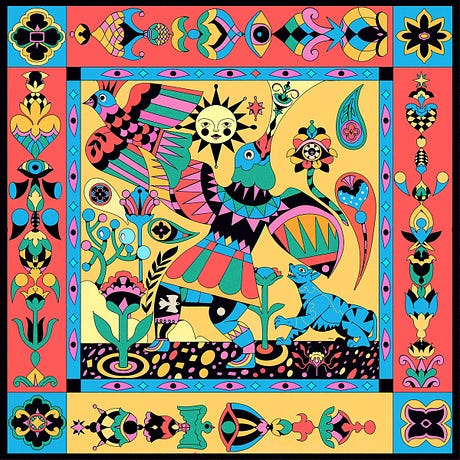
Featured art for CAE 57CAE 57’s featured artist is French illustrator YoAz, whose vibrant and bright images are a composite of comforting shapes, animals and bold colours. In his own words, his style mixes structure with playful, psychedelic elements, often exploring movement, rhythm, and visual storytelling. You can find him on Instagram, and a selection of his prints are available for purchase via a Redbubble shop. Of all his images, I kept coming back to this one, and it is this month’s pick for CAE 57.
The most interesting things I read this monthStart here:Start here for my faves, then fill up your browser tabs with the pieces below. 🔠 Life’s Rich Pageant How A Campy 1970s Game Show Became Part Of Canada’s National Lexicon. As a Canadian, I couldn’t leave this piece out of CAE for the month! Campy as ever, as the article’s title suggests, The Gong Show was hosted in the 1970s by Chuck Barris and consisted of comedy and music segments scored by a panel of C-listers. The acts were “gonged” off the stage if they were terrible. I didn’t know that using “it’s a gong show” to describe something that was a low-stakes but an overall mess was a piece of Canadiana until I read this piece. I thought it was a North American expression. But no: it first emerged from the show to mean anything that was bad, to now evolve into something the show also embodied: chaos. This piece traces the term’s quiet evolution in more depth than I expected; the article came to be after the author Stefan Fatsis worked with Merriam-Webster. So he knows his words! He was able to do rummage around “gong show” on the job, to our benefit. “Words migrate,” he writes, “they ride on airplanes and optic fibers over mountains and under oceans, thumb their noses at state and national borders.” A delightful article, through and through. Defector 🌰 Nearly a Century Ago, American Chestnut Trees Died Off. Now, Hikers Can Walk Among Them Again. A friend did her thesis on American chestnut trees, so as with anything you have a small connection to, the title caught my eye and I dove into this read on how it has been coaxed into a comeback. Nearly a century ago, American chestnuts were one of the most abundant and ecologically important trees in the eastern US. However a fungus entered trees through wounds in their bark, spread around “stems and limbs” and destroyed their vascular system so much that they couldn’t make a recovery. While new sprouts often emerged, they rarely grew large enough to flower. By 1941, the blight had eradicated 3.5 billion (! )American chestnut trees and rendered the species functionally extinct. But, “the ghost of the chestnut still haunts the woods,” Eric J. Wallace tells us; and now, hikers may finally glimpse its return. Through decades of work by scientists and volunteers, breeding blight-resistant hybrids, mapping surviving stumps, and replanting seedlings, the American chestnut is slowly reclaiming its place. Citizen scientists and hikers are part of the comeback story, reporting sightings and helping restore what used to be called the “redwood of the East.” Backpacker 🧠 Aging Out of Fucks: The Neuroscience of Why You Suddenly Can’t Pretend Anymore. A whole piece about the aging brain’s middle finger to people-pleasing. Ellen Scherr write about what happens around midlife when suddenly you find yourself saying what you actually think instead of peddling to social harmony. Is people pleasing a pathological trait? Definitely not, but it was an interesting read about why the lack of cushioning or apology becomes easier as we age, something Scherr calls the “Great Unfuckening”. We all know that being ‘direct’ doesn’t equal being rude; there’s a big chasm between the two. But for many, passive aggressiveness is the cultural norm. Scherr writes about how there is a moral biological and hormonal re-wiring in the brain that overwrites our social choreography. The result is that social performance less automatic, for women especially (though also for men!), likely because social conditioning has long encouraged women to suppress their needs or avoid being seen as “difficult” in order to maintain peace. “You’re not becoming difficult,” Scherr states. “You’re becoming free.” Life Branches 🫄🏼 The birth keepers Childbirth Influencers made millions pushing ‘wild’ births – now the Free Birth Society is linked to baby deaths around the world. This jaw-dropping investigation into the Free Birth Society (FBS) tells us about how the movement was initially started by two former doulas, and billed (by them) as an act of empowerment. Over time and fuelled by social media, it had dangerous and deadly results. Not that you needed a piece to tell you that “wild pregnancies” and childbirth without medical care could be dangerous. FBS discourages prenatal visits, hospital transfers, or even interventions even when complications arise, repackaging distrust in medicine as “choice” and “freedom” (sound familiar?). Worldwide, stillbirths, neonatal deaths, or serious harm were linked to families influenced by FBS teachings, all potentially preventable. I’m a perfect example of how iatrogenic injury can be life-changing, but I wouldn’t want to eschew medical care for something as crucial as bringing in another life. The Guardian 💢 The Pelvic Floor is a Problem. (Archive link) According to one paper, more than 25% of reproductive-age people globally have some form of pelvic floor dysfunction, including chronic pain, pain during sex, incontinence, organ prolapse, and a host of other poorly understood conditions. And that’s only the cases we know about. The pelvic floor discussion only recently become part of a more public discussion in the West, but since it “contains all the doorways” for areas that were long taboo, Casey Johnson writes that it certainly won’t become common party conversation. And myths abound. For example athleticism doesn’t make the area more functional. So, what does? Learning to engage it directly, it turns out. Basically, managing the pelvic floor is a skill, and one that the professionals Johnson interviews note is being mis-taught on social media. The piece is part personal narrative, part deep dive into the murky morass of bad information to give us the straight facts. WIRED Mag ☀️ Why Solarpunk is already happening in Africa. For those unfamiliar, Solarpunk is a political vision that imagines a future built around decentralized renewable energy, low-carbon living, and community-driven infrastructure. A counterpoint to more dystopian climate narratives, the movement looks to integrate tech with nature and scale up from hyperlocal adoption. This piece argues that the movement is no longer hypothetical in Sub-Saharan Africa, where limited existing infrastructure works to an advantage because communities aren’t locked into aging centralized energy grids. With cheaper solar hardware costs happening in tandem with the rise of mobile money platforms, some solar startups have been able to scale in the region quickly, bringing electricity to millions of households that previously had none by selling solar panels to farmers on payment plans. It’s not a simple proposition, don’t get me wrong! You still need a list of different factors to be in place. But the author’s point is that this is a very different model to government-led megaprojects, one that we don’t often hear about in North America. Climate Drift ⛩️ Every Tree Can be a Buddha. This is a lyrical read by my friend Jason Kottke, who recently traveled to Japan. In it, he reflects on his walk along the Chōishi-michi pilgrimage route that leads from the town of Kudoyama to the sacred Mount Kōya, with 180 stone guideposts (choishi) along the way (“You don’t want your pilgrims getting lost,” Kottke writes.) After all, “how are you going to find eternal salvation if you can’t even make it to the temple?” Reading it is a reminder to nurture our connection to living things in reverence and stillness, something easy for us all to forget. The pilgrimage route is a UNESCO World Heritage site, but this essay focuses on each tiny moment of the hike, in first person. It made me wish I was in a forest myself, though it’s -20C outside so… wishful thinking on multiple fronts. Kottke 🌱 How a humble weed became a superstar of biology. So interesting! Rachel Ehrenberg takes us on a remarkable journey, sharing the story of how a modest weed turned into one of the most-studied model plants in biology. Once dismissed as a simple annoyance in the mustard family, Arabidopsis thaliana became a botanical superstar when researchers realised its tiny size, fast life-cycle and simple genome made it ideal for experimentation. Over the years, it’s helped scientists research plant genetics, stress responses, and even immunity, and led to breakthroughs in agriculture and biotechnology. It didn’t happen in a vacuum though; the article goes into how the research community rallied around the species by building databases, sharing tools, and publishing tens of thousands of papers. I had never heard of this lab mouse of the plant world before reading. Knowable Magazine 📰 Why College Students Prefer News Daddy Over The New York Times. (Archive link) This Verge piece, entertainingly designed, discusses how TikTok and Instagram now function as the primary news pipeline for Gen Z students, even among students who intellectually understand that social platforms are unreliable and algorithmically addictive. (A recent survey found 72% of college students get their news from social media.) This includes sources like the UK-based News Daddy, whose rapid-fire TikToks have collected 1.5 billion likes and who effectively serves as a “news anchor” for millions. Though the students interviewed know that News Daddy doesn’t cite all its sources, and misinformation travels quickly on TikTok, they say that the updates feel more “connected to the people” than traditional newsrooms do. Some students do use Google searches to double check questions from social media-fed news, especially when comments to the post say that something is inaccurate. The problem is, Google searches often yield an AI-generate summary as well at the top of results, and they don’t always click further. Nor is that summary always accurate. So they’re still not reading the actual sources. It’s like AI is the “new Wikipedia”, as a professor put it. In the end, convenience wins. The Verge 💍 The Trad Movement Is Sputtering. Here’s What Comes Next. Filming and sharing trad content was once a winning strategy to go viral: invoke traditional values, then “frame it as bold truth-telling” and wait for outrage to drive engagement. But its veneer is peeling away, and it per Katherine Dee it no longer hits the way it did a few years ago, resembling a fleeting internet instead of an emerging counterculture. So what happened? For one, Dee argues that the tradwife wasn’t truly counterculture, because the aesthetic was only defiant in progressive spaces — there was no rebelling within conservative circles. So it was an easy way to get a rise out of people, and a carefully crafted backlash to girlboss / hustle culture. But it was just a different business model in the end, a performative act. “If you weren’t a creator, you were a customer,” Dee zings. So what is counterculture? Per Dee, if empathy doesn’t scale on social media, then creating art quietly is today’s true counterculture. Quoting Biz Sherbert, she writes, “if mass culture runs on conflict, then the only real counterculture left is love.” I didn’t expect this piece to veer into the existential, and I enjoyed where it went. GQ 🌊 Carnivorous “Death-Ball” Sponge Among 30 New Deep-Sea Species from the Southern Ocean. It’s in the ‘best of’ section for the headline alone, honestly, but the slideshow that accompanies this post is worth several minutes of your time. As the headline suggests, 30 previously unknown deep-sea species, including a carnivorous “death-ball” sponge, a new predatory sponge (Chondrocladia sp. nov.) whose spherical form is covered in tiny hooks that trap prey. For the sponge-amateurs, this is in serious contrast to the gentle, passive, filter-feeding behaviour displayed by most sea sponges. (Bonus, there were also zombie worms (Osedax sp.), and though they’re not new to science they are also weird and fun and have no mouth. Slideshow, I’m telling you. Go click on it. Ocean Census 🅿️ Yes, There’s a Parallel Parking Championship, and I Was a Contender. Fun! The skill of parallel parking gets its moment in the spotlight at the annual Pittsburgh Parallel Parking Championship, a grassroots-driven (pun intended) contest where drivers race the clock and their own nerves to slide into a curbside space. Held in Pittsburgh’s Lower Lawrenceville, competitors are aiming for not just speed but also precision. Like preferences for olives, parallel parking skills aren’t something you just ‘aren’t sure’ about; you definitely know if you’re good or terrible at doing so. Rules mix time and distance to the curb, and even factor in vehicle length, with disqualifications for kissing the curb or touching an adjacent car’s bumper. The event’s creator characterizes it as “weird, kind of stupid, and everyone ends up having a really good time.” Can’t go wrong! Car and Driver 💬 The Therapy That Can Break You. As part of the “throw all of the spaghetti against the wall” trials I’ve done when my life changed dramatically due to spinal CSF leak, Internal Family Systems (IFS) is a modality I’ve tried for grief work. It treats the mind as a constellation of “parts,” a framing that has spread rapidly through social media in recent years. It has also attracted sharp criticism. In this piece, Rachel Corbett follows an IFS-oriented eating-disorder clinic where a teenage patient suddenly accused her father of abuse, allegations a judge later deemed not credible. Former patients describe IFS sessions that felt untethered from reality, with some people crawling or switching, age, gender, or even species. Critics argue that IFS’s evidence base is thin and that, for vulnerable people with complex trauma, eating disorders, or psychosis, it can destabilize more than it heals. But IFS’s founder, Richard Schwartz, counters that the real problem is inadequately practitioners using the approach indiscriminately. Having only encountered IFS within general therapy (not inpatient clinics), I’ve found its concept of ‘parts’ useful and actionable, making it all the more sobering to read how the same framework can become harmful when misapplied. The Cut 🤥 Two part read: Investigating a Possible Scammer in Journalism’s AI Era, and The Fallout From Our AI Freelancer Investigation. Victoria Goldiee seemed like a freelancer with a promising pitch and bylines at a series of impressive outlets, but alas it was not the case. After Hune-Brown dug into her published work, he found fabricated quotes from real people and other tells that something was awry. By the end of his investigation, publications including The Guardian and Dwell took down her stories. Today’s publishing landscape is a difficult place to build a career as a freelance journalist, but as Hune-Brown notes, “it turns out, it’s a decent enough arena for a scam.” The follow up piece is a great interview musing on the how and why of what happened. The Local 🪦 Can my dead uncle’s phone break the cycle of addiction? Would you rather have a fully nude, open casket funeral or an open ‘information corpse’ funeral, your unlocked phone and laptop available for mourners to scroll through? Writer Kiki Dy dives into this uncomfortable question in her essay about her uncle’s death and her subsequent inheritance of his unlocked phone. Dy interviews Carl Öhman, a researcher who coined the term ‘information corpse’, the vast digital data (texts, searches, photos, social media) left behind after someone dies. Old phone texts and photos, once private, become raw data; reading them can feel like a violation, but also like the only way to confront grief honestly. The Sunday Long Read The rest of the most interesting things I read this month:🇨🇦 ‘Mind-blowing’ population of feral goldfish in Ottawa pond to be euthanized. My town of Ottawa, Ontario is learning how difficult it can be to remove goldfish from a new habitat once they’ve taken root. A pond here now houses thousands of goldfish, all potentially descended from a discarded pet. It’s crazy to think how one throwaway act (literally) can have such ecological effects, but that certainly isn’t limited to goldfish. Anything that disrupts balance can do the same, as New Zealand knows best of all. Goldfish are native to China, Hong Kong, Japan, and the Republic of Korea, and in many areas of North America they have no known predators — meaning they can quickly overwhelm an ecosystem and outcompete local species of fish. Short piece, but I’m including it because of that reminder. CBC 🎁 Presents of Greatness. Speaking of Canada: this gift guide is among my favourites from the many that I’ve seen this year, because of its delightful mix of chaos and whimsy. Plus that punny title, right? From the crocheted pizza rat purse you didn’t know you needed ($14 CAD!) to the splurgiest of pants (Arc’teryx’s exoskeleton pants that come in at an eye-watering $7,016 CAD), this guide has 120 or so gift options, many of them Canadian makers. I realize my email list is not all Canadians, but it was such a fun round up I wanted to include it. Toronto Life 🖋 How pen caps work. The title says it all: the author recently learned how pen caps work, thought it was interesting, and shared it with the world. It turns out that it isn’t only that putting a cap on a pen keeps it dry, but also that taking a cap off a pen makes it ‘wet’ again, because it draws the ink from the reservoir through suction. Also, please note that I am obsessed with the publications’s name: Overthinking Everything 🌿 The ‘Godmother’ of Weed vs. Her Uncle, the DEA Agent. A longread about local NY news with family betrayal thrown in, written in an engaging style. Eleni Polinski built her “Godmother’s Garden” brand into a luxury, award-winning cannabis company in Brooklyn, cultivating rare strains with her partner Steven Bubis and sharing gorgeous photos of them on her Instagram feed. In October 2024, while Eleni was in Florida, her home was raided by over a dozen police and firefighters, triggered by an anonymous tip about domestic violence (though she wasn’t there). Her uncle, a former DEA official, “scorned Eleni’s ambitions as criminal activity”, so suspicions abounded in the family. No DV or weapons were found, only high-volume of plants and cannabis products, but due to the volume of cannabis, Eleni, Steven, and her mother were arrested on felony possession charges. These charges that were later dropped. “The raid and subsequent charges highlight how razor thin the margin can be between whether a person in the cannabis industry is celebrated as an entrepreneur or charged as a criminal,” writes Rosalind Adams. Understandably, what unfolded also damaged the family’s relationships in the process. Polinski is still in business. The City 🎓 Grading Is Broken. (Archive Link) I was last in school in 2001, when I graduated from law school. And reading this article, it’s clear that education is a different landscape than it used to be. A recent report out of Harvard noted that students “almost universally” speak about grades in terms of how much effort they put in. So, if they spent a lot of time and put in the work, they believe they should get an A. The piece notes that this erroneous belief may explain why students are also more willing to argue about their grades these days. And it’s prevalent not just at Harvard, but elsewhere. But what can be done about it? The solutions suggested in the Harvard report include resetting grading averages and returning to traditional teaching options like in-class exams. But many professors feel like it’s a “race to the bottom” as an overall system of what grades represent in education, and there is little consensus about how to fix it. The Chronicle of Higher Education 😵💫 How to Stay Sane in a World That Rewards Insanity. Very short post, but one I thought CAE readers would enjoy. The prescription for sanity involves: (1) diversifying your information diet in ways that feel actively uncomfortable (as in, expose yourself to alternate views); (2) practice distinguishing between stakes and truth, and (3) find (or at least, look for) communities that reward humility, not tribal loyalty. Basically, a place where “I don’t know” is considered a reasonable answer. Field Notes on Now 💸 Meta is earning a fortune on a deluge of fraudulent ads, documents show. Meta projected 10% of its 2024 revenue would come from ads for scams and banned goods, documents seen by Reuters show. According to these leaked internal documents, Meta’s platforms show users 15 billion scam ads a day. Among its responses to suspected rogue marketers: charging them a premium for ads, and issuing reports on ’Scammiest Scammers.’ But not actually taking them down. Reuters 🇺🇸 Seven data-driven lessons from the 2025 elections. The title references to the recent American off-cycle elections, and is a good summary for those who aren’t following closely. The TL;DR is that Democrats outran their polls and swept statewide races from Georgia to New Jersey on an agenda of affordability and a broad anti-Trump backlash. The rest of the piece goes into what that means for the future, and includes lots of charts to back the conclusions cited. Strength In Numbers 🌾 Scientists Just Created a $10 Gluten Test That Works in 2 Minutes. Relevant to the fellow celiacs out there, this short read details how a lateral flow strip test flags any food with more than 5ppm of gluten with 98% accuracy, and even recognizes cross-contact with gluten from shared kitchen implements or dishes. Food and Wine 🍞 Poorer brain health in celiac disease and other gluten-related disorders is associated with a specific antibody triggered by gluten. On the same topic: a new UK-based study has found that a specific antibody triggered by gluten called Transglutaminase 6 antibodies (TG6) is linked with poorer brain health in people with celiac disease or other gluten disorders. The researchers found that those who tested positive for TG6 reported worse symptoms of depression and physical functioning, and non-celiac participants even showed accelerated brain atrophy on MRI scans. While further research is needed, this antibody test could become a tool for identifying patients with more severe neuro consequences of ingesting gluten. Beyond Celiac 🥡 The Innovation That’s Killing Restaurant Culture (Gift Link) All about how food delivery has changed restaurants worldwide. In 2024, nearly 3 out of every 4 American restaurant orders were not eaten in a restaurant, and even take-out orders have dwindled comparative to delivery. 41% of respondents in a recent poll said that delivery was “an essential part of their lifestyle”; more than half of adults under 45 use delivery at least once a week, and 13% use it once a day. (5% use it multiple times a day!) The piece talks about how delivery has reversed the flow of eaters to food, but also has remade a shared experience (of the dining itself in a restaurant) into a much more individual one. I can’t eat out due to being disabled, and I’m grateful for delivery as option — but I fully understand how those in the restaurant business must be finding it a big change. The Atlantic 📐 First Shape Found That Can’t Pass Through Itself. A shape called a ‘noperthedron’ (lol) is the first known convex polyhedron that cannot pass the Rupert Property — meaning it can’t pass through its own shape. This is called the Rupert Property because in the 1600s, Prince Rupert of the Rhine won a bet about whether a tunnel can be cut through a cube to allow another cube of equal size to pass through. Got all that? Me neither, but thankfully Quanta has made us some illustrations to help us understand. Quanta 🇳🇬 Car battery recycling is fueling lead poisoning in Nigeria. The auto industry touts battery recycling as an environmental success story. But in Ogijo, Nigeria, recycling factories that supply lead to the US automotive industry are coating surrounding residential areas in toxic lead dust. The Examination. Thanks for reading ♥ Subscribe to receive next month’s Curious About Everything—it’s free! 🔗 Quick links
|