You’re reading Read Max, a twice-weekly newsletter that tries to explain the future to normal people. Read Max is supported entirely by paying subscribers. If you like it, find it useful, and want to support its mission, please upgrade to a paid subscription! This newsletter is brought to you by Squarespace.
I love my Substack newsletter, but I don’t want it to be my only online presence. And for a variety I don’t really like making social-media accounts the central hubs for my professional work. Which means I’m fully bought in on having a personal homepage--and for mine, I used Squarespace. (You can see it here.)
Squarespace makes the design and publishing part of the equation excessively easy. If you need a domain, Squarespace can register one for you. You don’t need to know HTML or CSS, or figure out how and where to upload your files. You can pick from a huge number of templates, and then radically customize them yourself, whether you’re looking for something tasteful and professional or something a bit, uh, weirder. Even better, it’s endlessly flexible and versatile. If I want to start up a Read Max shop to sell merch next year? I can use Squarespace no problem. If I want to set up a secondary email list for use separate from Substack? It can do that too. And because it’s my site, and not an account on a platform, I don’t need to mix business and pleasure (or worry about trolls). Click here to try it out, and when you’re ready, use READMAX to save 10% off your first purchase of a website or domain.
Greetings from Read Max HQ! In this week’s issue: What is “slop”? A reminder: The above advertisement notwithstanding, Read Max is 99 percent funded by paying subscribers. I read, research, report, and write with time that’s paid back by paying subscribers, whose money not only funds my housing, food, childcare, etc., but also subsidizes the many readers who aren’t paying. If you can afford it, and if you value the independent criticism, journalism, and thought represented by Read Max (for better or worse), please consider upgrading to subscribe. At $5/month, it’s only about the cost of one beer, depending on where you live!
What is slop?
“Slop” is Merriam-Webster’s word of the year:
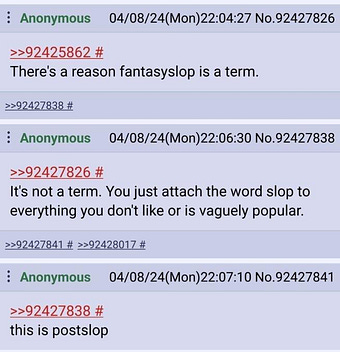
This seems fair enough as a descriptive matter. If you say “slop” to your parents, they will assume you’re talking about “low-rent, scammy garbage generated by artificial intelligence and increasingly prevalent across the internet” and the various associated aesthetic qualities, i.e. a particular quality to an image’s light and framing, or “repetitive words and phrases that are instantly recognizable as AI generated text.” But “slop,” as a bit of online slang, hasn’t always denoted the involvement of A.I. In fact, it wasn’t until early 2024, thanks in part to the A.I. writers Simon Willison and Deepfates, that “slop” became closely associated with A.I.-generated content; before that, it was a generic byword for what Know Your Meme characterizes as “content online that is considered low effort and only meant to barely entertain people who watch it,” a meaning cemented by the YouTuber Pyrocynical and his fans. For many years “slop” as a slang term wasn’t limited to “content online,” or even to “content” at all, except in an expansive sense: We can probably locate the term’s distant origins on 4chan, where the anti-Semitic joke “goyslop,” coined in 2016, became a common way to refer to cheap processed and fast food. Even as the “weird fake A.I. crap” definition of slop cements in the public consciousness, this broader idea of slop (shorn, to be clear, of any particular anti-Semitic overtones) still has purchase today, most often when used as a suffix denoting a kind of easily consumable cheapness, interchangeability, and semi-coherence: such as, say, “fantasyslop,” for rote, effectively identical, wish-fulfillment fantasy novels and stories, churned out for quick consumption by an eager and undemanding audience. In its use as a modifier, “slop” suggests a set of qualities--forgettability, predictability, unoriginality, lifelessness--rather than a particular origin. Humans can and do produce “slop” in this sense with no A.I. involvement, though consumer-oriented generative A.I. seems engineered to accelerate or expand the production of slop as such. And in a world that can feels geared to produce adequacy, uniformity, and convenience, you can see the appeal of “slop” as a suffix. I’m sure you’ve encountered self-explanatory terms like “Netflix slop” or “Marvel slop” in the wild; but these are only the beginning of the many forms of slop you might encounter. This morning in my inbox I received a newsletter about “primaryslop,” which is when primary candidates’ “personality and rhetoric [are smooshed] into a kind of smooth paste made up of ‘fight’ ‘[STATE/DISTRICT NAME]’ ‘voice’ ‘believe’ ‘change,’ etc.”) Someone who doesn’t like the cliché you’re bandying about might accuse you of purveying “sayingslop.” (“Profound-themed,” in this case.) Across various online dictionaries and encyclopedias, less-recognizable taxonomies of slop are produced: “friendslop” is “low-budget, low-stakes and often humorous co-op video games sold at bargain prices”; “fagslop” is “yaoi works of low quality and broad appeal”; “wordslop” describes muddled, buzzword-heavy non-jokes. Nor is Read Max immune: when I was searching recently for a quick way to describe the many undifferentiatable and uninspiring (but no less popular because of it) vehicles produced under the strictures of contemporary automobile design, I went immediately with “carslop.” But: do I have a clear sense of what slop is, besides in the Potter Stewart sense? What are we gesturing at when we use “slop” as a suffix? All the adjectives I’ve already used give us a kind of affective definition of slop: cheap, low-effort, convenient, consumable, interchangeable, forgettable, predictable, unoriginal, uninspiring, lifeless. But I tend to think that these affective dimensions of slop arises from a deeper structural dynamic, out of which we could build a more formal definition of “slop.” One idea I’ve been circling around is that “slop” is that which is “fully optimized” to its domain to the point of texturelessness or characterlessness. “Slop” in this sense is anything designed to be as easy as possible to produce, sell, and consume, but it’s particularly slop at the point where all or most other players in the same space adopt the same strategies, and the material is no longer individual or differentiated from its competitors.¹ Classic A.I. slop--i.e. “it’s my birthday”-type images--obviously qualifies here as content “fully optimized” for the Facebook feed or TikTok FYP.² But so too do Save-the-Cat-style scripts--“fully optimized” for the writer, the executive, and the audience, but also rote and indistinct--which are scriptslop. Aerodynamically efficient crossover S.U.V.s are carslop. The defensive shift is baseballslop. The crab-like body-plan is crustaceanslop. And so on. I like this definition for its versatility, but I’m not wholly bought in on it. Among its weaknesses, it allows for things that are fully optimized for the better to be defined as “slop”: “Carslop” is not necessarily slop to people who are maximizing for reliable operation rather than striking design. (For that matter, everyone makes basically the same hammer; is the hammer “toolslop”?) On Bluesky, squarely rooted suggested narrowing the definition to “a low-to-zero marginal-cost substitute for something valued, or something being aggressively positioned to substitute for craft,” which helpfully re-imports the idea of cheapness or shoddiness that might otherwise get lost. (On the other hand, in the same way that boring crossover S.U.V.s might not be carslop because they satisfy customers, couldn’t the same thing be said about Netflix true crime docslop?) I also appreciated Kevin Baker’s more formal (but not necessarily mutually exclusive) conception of slop “as the negative platonic form: not the ideal that particulars aspire toward, but the silhouette left when you subtract everything that would make a specific instance rather than a thing of a type. What remains when you’ve successfully avoided all such situatedness.” (Glossed neatly in his mentions as “antihaecceity.”) But I remain drawn to my original definition of slop, even as I acknowledge its weaknesses, because I think it correctly emphasizes the forms and conditions of slop consumption, rather than focus solely on the means of its production. “Slop” is probably better positioned as a symptom of “the feed,” the binge-watch, the subscription service, and an overall culture of convenient consumption than it is as a symptom of a particular technology. Put a little more directly, maybe we should start thinking of the technology of generative A.I. as a product of a culture of slop than the other way around. 1 In gaming terms you might think of “slop” as the tactics used in a solved game or stalled-out meta. I don’t play Hearthstone anymore, but I think of the flood of cheaply copied, e.g., aggro Hunter decks that would come around every expansion as a form of slop. 2 One thing to note here is that under this definition of “slop,” what makes A.I.-generated content “naturally” “slop”-esque isn’t on the one hand the jankiness or strangeness of the images or text, nor on the other the probabilistic predictive nature of the models. Instead, what makes it “slop” in the “optimized for consumption” sense is the R.L.H.F fine-tuning, during which a model is trained to generate output that will be highly graded by a human reviewer. As we’ve discussed previously, given the incentives of both the individual reviewer and the A.I. company building the model, this process tends to produce safe, boring, homogenized output designed to be immediately pleasing and frictionless to consume: i.e., slop. You're currently a free subscriber to Read Max. For the full experience, upgrade your subscription.
|