Monopoly Round-Up: Corporate Lawyers and Fat Envelope AmericaFormer antitrust enforcer Roger Alford blasted the ABA Antitrust Section before Congress. Plus, Gavin Newsom raises electricity prices in California, the FTC sues Uber, and TikTok gets fake sold.
Things are going to slow down this week and next, since it’s Christmas, but there was lots of monopoly related news this week. What looks like a fake sale of TikTok was announced, the FTC sued Uber, and a former FTC enforcer exposed private equity’s role in youth sports. Before getting to the round-up, I want to focus on three events that unmask some behind-the-scenes villains in the Trump era, as well as the pushback that’s happening behind the scenes. Let’s start with the villains. As we know, both Netflix and Paramount are seeking to buy Warner Bros Discovery for $100B+, in order to consolidate Hollywood. Paramount owner David Ellison openly told Donald Trump he’ll change CNN if allowed to buy the firm, in order to get permission to buy the firm. Netflix’s CEO Ted Sarandos also met with Trump, and no doubt that plus antitrust lawyer Steve Sunshine’s political analysis is why the Warner board agreed to sell to that bid. Well, a few days ago, the Wall Street Journal and Politico reported that both Netflix and Paramount are employing the same lobbying firm, Ballard Partners, where both Attorney General Pam Bondi and White House chief of staff Susie Wiles used to work. Ballard is the lobbying funnel for most major corporate deals under Trump, and has a strong whiff of corruption around it. Several Senators are demanding Bondi recuse herself. But basically, everyone in corporate America is openly saying they can use a fat envelope to overcome that pesky rule of law thing, and Ballard seems like the post office for these fat envelopes. The thing is, surrounding all of these deals aren’t just lobbyists, but oodles of antitrust lawyers. Well-credentialed, well-paid corporate lawyers. Corporate lawyers who have all sworn an oath to the Constitution, to the courts, and to honesty and virtue in their representation of clients before the law, who are in good standing with the American Bar Association Antitrust Section. And many of them have, Democrats and Republicans, wholly and eagerly embraced the corruption of the Trump era. So those are the villains. Perhaps that is not so shocking. But what is surprising is that there is actually pushback. On Wednesday, there was a little-noticed procedural hearing over a little-noticed merger that closed six months ago, the $14 billion combination of Hewlett Packard and Juniper Networks. The deal isn’t important in and of itself, but the debate over the deal within the Department of Justice set the tone for the Trump administration’s approach to antitrust, prompting shouting matches inside the Department. MAGA-connected corporate lobbyists demanded the Antitrust Division allow the merger through, while MAGA populists running it said no. It culminated in a de facto coup, where corporate lobbyists seized control of enforcement from the Senate confirmed leader, Gail Slater. While most scandals under Trump go away, this one hasn’t. After being fired, Alford publicly alleged that lobbyists paid by powerful corporations are now in charge of antitrust enforcement. “MAGA lobbyists reportedly are liberally pitching their services to clients, starting at a mere $225,000 a month—more than the annual salary of senior DOJ officials,” said Alford. “When asked what services they provide beyond what the law firms offer, these lobbyists will openly say that they will go above and around the Antitrust Division to lobby their case, and even seek to have Gail Slater removed from her Senate-confirmed position.” According to The American Prospect, Alford named “Bondi’s chief of staff Chad Mizelle and associate attorney general nominee Stanley Woodward as betraying the MAGA realignment of working-class voters by selling merger clearance to the highest bidder, concerns that he says are ‘not based on conjecture.’” It was so embarrassing for the administration that Mizelle resigned in September. But the pushback isn’t over. It turns out there’s an old anti-corruption law called the Tunney Act, which says that antitrust settlements with the DOJ must be approved by a judge. And since the DOJ settled HPE-Juniper deal, there’s a judge, a former labor lawyer named Casey Pitts, peering over what happened. And now multiple Democratic state law enforcers, who also have jurisdiction over this merger, have asked that judge for the right to get documents that might show how the HPE-Juniper settlement was arranged, aka unveil the stink of corruption. Pitts just said he was “sympathetic” to their request, though he didn’t rule on it yet. And the heat on this deal continues to slowly ratchet upwards. On Tuesday, Alford himself testified at a hearing before the House Antitrust Subcommittee, laying into the corruption he saw, and the failure of the legal establishment to act in ethical ways. But Alford broadened his critique beyond the lobbyists, to the clique of powerful lawyers and law firms who control antitrust law and who work with those lobbyists. He fingered former Obama antitrust chief turned Amazon lawyer Renata Hesse:
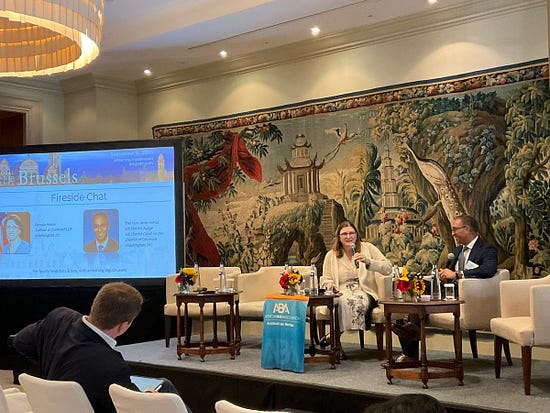
By way of background, Hesse is a respected D.C. fixture, with a long track record in Democratic politics and a lovely refurbished Maryland Eastern Shore house recently featured in an Architecture Digest-style article. She’s also a partner at the prestigious law firm Sullivan & Cromwell, and is the current Chair of the ABA Antitrust Section, which is the important organization that represents defense-side antitrust lawyers. Her silence, and that of other ABA Antitrust Section members, is important. During the Biden administration, you couldn’t attend an American Bar Association Antitrust Section event or read something in the set of trade publications around antitrust without encountering an angry and public rebuke of Lina Khan’s lawlessness simply because Khan shifted enforcement priorities. Today, faced with routine corruption around antitrust law, big law defense lawyers are silent. In fact, big law defense antitrust lawyers regularly advise their clients to play the influence game, as we’re likely seeing with Netflix-Warner Bros. Hesse isn’t silent on everything. In September, she did a friendly fireside chat with Judge Amit Mehta in Brussels, who was fresh off his remedy decision to let Google get away with monopolization. It’s not clear who paid for this session in Brussels, but it’s a common theme for the ABA Antitrust Section to celebrate judges who go easy on corporate defendants.
So why does this silence, and Alford’s critique, matter? The ABA Antitrust Section is a major force in shaping antitrust law, and not just through their annual Spring conferences that bring together thousands of practitioners, or their anchor as the organizer of lawyers in the specialty. They also have a committee dedicated to offering comments in administrative dockets, which they do both domestically in cities and states, and in countries all over the world. Most people assume they speak for the legal professional itself, and that’s because the ABA Antitrust Section, in its comments, says it speaks for 12,000 antitrust attorneys and experts. So its comments carry weight. But the section is actually run by a very narrow group, and the ABA Antitrust Section doesn’t allow its broader membership to vote on these comments. The committee on comments can be seen here. Only 1 of 4 Co-Chairs has a pro-enforcement background, and 0 of 4 Emeritus Co-Chairs do. Several are foreigners who facilitate international mergers. And the content of the comments shows it. Take this May submission to Great Britain’s Competition and Markets Authority, encouraging them to approve more mergers with “behavioral remedies.” Or look at the April submission to the U.S. government, which argued that incumbent utility monopolies should be able to exercise a “right of first refusal” on energy projects. These are extremely boring ways of saying that antitrust law should facilitate more monopolization. And that’s the voice of the American antitrust establishment saying this. The ABA Antitrust Section’s ardent defense of big business is not new. The modern anti-monopoly movement really picked up steam ten years ago. At the time, on the right, Donald Trump ran for President and attacked monopolies as part of his campaign, while on the left, Senator Elizabeth Warren started to talk about the problem of antitrust. In 2016, both parties put antitrust in their party platforms for the first time since the early 1990s. Despite this interest on both sides of the aisle, the antitrust bar was unmoved. In 2017, the ABA Antitrust Section, disavowed the criticism.
Since 2017, the antitrust bar has been under constant assault, with the public increasingly frustrated at the surfeit of lawlessness and trickery the bar has unleashed on them. Their response has been, well, hostility. In fact, the meanest audience I’ve ever addressed was the ABA Antitrust Section in May of 2023, when I was invited on a panel to defend the Biden administration’s policies. It was so jarring I wrote it up in a piece titled “The Rage of the Corporate Lawyer.” The resistance of establishment antitrust lawyers has softened a bit, since there’s been a wave of plaintiff litigation, which means that there’s more work using antitrust law in private practices. But it hasn’t softened by much. Indeed, the flip side of the rage that we saw during the Biden era over enforcement and what they felt was a flouting of the rule of law, can be contrasted with the silence today by those same lawyers, who don’t mind pay-to-play, or even hiring corrupt lobbyists to serve their clients. Maybe Hesse sees this dynamic, and will be a new kind of steward for the ABA Section. Alford certainly gave her the opportunity to speak out, if she wants to. If she doesn’t, well, sometimes, you don’t need to say anything at all to let everyone know what you really think. The question is whether we will remember this silence in a few years, or will revert back to admiring the prestigious institutions in which these lawyers operate. And now, the rest of the monopoly round-up, after the paywall. The Trump Federal Trade Commission is looking into Instacart over the personalized pricing scandal exposed last week, Trump is preparing a new executive order to block stock buybacks at defense contractors, and a sale of TikTok’s U.S. operations was quasi-announced, though it looks pretty fake. Read on for more…... Continue reading this post for free in the Substack app
|