Where We're Going, We Still Need Idiots(I'd probably use the word "manifesto" here if I knew what it meant.)
Three and a half decades ago, I invented the perfect idiot. This was pre-internet times, at least in the part of Yorkshire I grew up in, and since I had recently decided to try becoming a professional writer, my options seemed limited. My best bet? Submitting something to the BBC Radio 4 Afternoon Play - a daily slot with an absolutely ravenous appetite for new fiction, offering hundreds or sometimes even thousands (!!!) of pounds for a really good story - and when they accepted my manuscript and I was officially Discovered by all the big talent agencies, I could sit back and watch the money roll in. Did I actually have a really good story? Not in the least. That would have required effort, which I tended to avoid, and writing skill, which I wasn’t yet aware I lacked. But hey, I had the next-best thing: I had a great character. Story is just character in action, right? Well then. Job mostly done! And wasn’t my character completely brilliant? Admittedly, it was heavily inspired by a few others. (“Stolen” might be a more legally-precise word.) I’d recently read W.E. Bowman’s magnificent mountaineering satire The Ascent Of Rum Doodle, and become greatly enamoured of its hapless protagonist, Binder - and then I discovered Terry Pratchett’s Corporal Carrot in all his heroic simplicity (which is not saying he’s stupid, as I previously explained here). My character - let’s call him M. - was incapable of thinking the worst of strangers. This Sketchplanations illustration of Hanlon’s Razor would be utterly wasted on him, because it would never even occur to him that other people might act out of meanness, cruelty and petty spite. I mean, why would they? That would be awful! In his blissful innocence, M. would enthusiastically blunder through the world, approaching each challenge with near-perfect innocence and getting taken to the absolute cleaners by every feckless scoundrel he met along the way. It’d be something of a black comedy, in that gently bleak way we Brits enjoy in our storytelling. Nothing would go terribly well for him, but he’d zealously persist in assuming the best intentions in other people. He’d be someone you could admire, yes, but only from a safe distance, outside the disaster-zone created by his chaotic passage through life. What I hadn’t yet realised is that when you fall in love with a fictional character that deeply, it’s probably your subconscious yelling something important back at you. Fact is - I’m M. The real me is a knee-jerk optimist who tends to assume nearly everything and everyone is more or less lovely and we’re (almost) all just doing our best to muddle through without making too much of a hash of everything. (For those reasons I should probably never be put in any sort of position of responsibility - but here we are, nearly five years into this newsletter, and I’m only going to double down on everything I’ve been doing. I reckon it’s your fault for encouraging me so much. Too late now.) Now it’s 35 years later since I created that unwittingly fictionalised version of myself, and while I’m a different kind of writer these days, I’ve remained that same kind of idiot. Am I really the right person for this particular job?
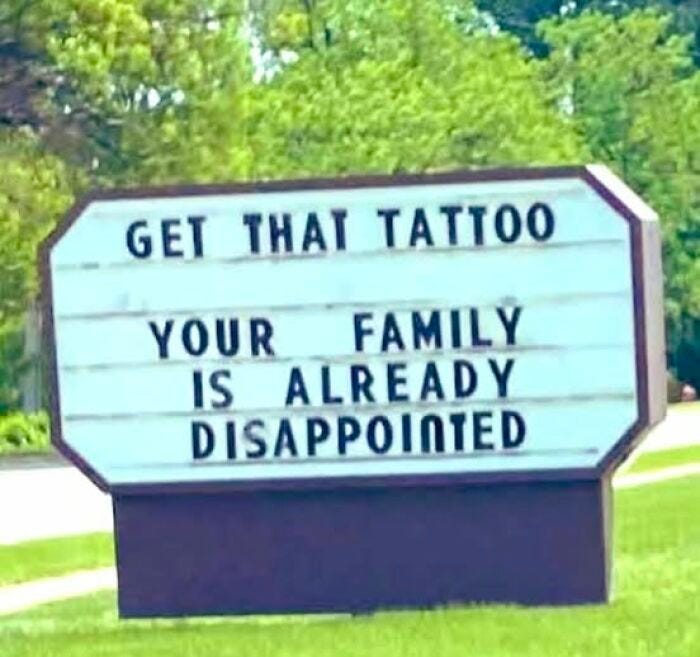
Right now I’m back in the Yorkshire town I grew up in, visiting relatives for Christmas, and it’s giving me plenty of time to think about all this. Is semi-fanatical cheerfulness really a good trait for writing a science newsletter? Is enthusiasm a genuinely trustworthy guide, or will it just send you careening head-first into all sorts of disasters more world-weary & less credulous people would better be able to avoid? Perhaps! At the very least, it’s certainly a recipe for being massively wrong at least some of the time. (But then, whispers the chronic optimist in me, so is pessimism - and since our attitudes also tend to influence our actions in ways we’re barely aware of, nudging them into mildly self-fulfilling prophecies, I know which one I’d rather invest my long-term emotional wellbeing in.) In a wider sense, the stakes feel higher for 2026. Cynicism remains as fashionable as it’s always been (both the doomism kind and the weaponised, gaslight-y varieties) - and the internet is increasingly defined by how angry and disillusioned its users are feeling, both about various online platforms and the state of the world in general. Meanwhile, science is under assault in the United States as its most impactful institutions are systematically dismantled - while everyone’s getting caught out by nonsensical slop pumped out by generative AI, making it harder to know who & what you can trust. The situation is better here in Europe and Canada and elsewhere in the world, but given America’s overwhelming influence upon the shape of the internet that connects us all, there’s a lot to push back against, and a lot to debunk. But I think this is important too:  As for how: I'm not going to tell anyone else in Scicomm how to do their jobs (especially as most are better at it than I am 😅).
But - as well as vital debunking work, we also need to work at making folk go "WOW!" at the real stuff.
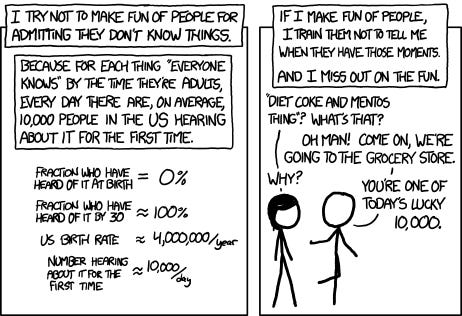
Debunking can end up promoting nonsense. We need to REPLACE it.  Tue, 09 Dec 2025 16:47:31 GMT View on BlueskyThat’s a thing I can’t seem to get out of my head: when you rage about how stupid a thing is, you also help it reach even more people. It’s not a clean, neutral process. Debunking nonsense is a vital part of what’s always needed - but it also comes with polluting side-effects that need offsetting. We still need reminding of all the things that can make this world feel like a joyful adventure, even while we’re learning how to rid it of the worst of its upsetting, hope-eroding garbage. For this reason, and however self-serving it may be to say it: nearly half a decade into Everything Is Amazing, I still think there’s a lot of value in taking the role of a world-enthralled Binder or Carrot - especially if you’re willing to broadcast your mistakes so others can have a good laugh at them (and not just for entertainment purposes). To return to an xkcd cartoon I’ve posted more than a few times in the nearly 5-year history of this newsletter…
Fun fact: I thought I was the narrator. The one on the right, confidently announcing “come on, we’re going to the grocery store.” But now I think I’m more like the one on the left - the clueless soul that some folk would roll their eyes at for not grasping some of the most basic aspects of modern life, but who is having great fun having his mind blown again and again as he first discovers them, which he does by assuming there’s almost always something amazing - AMAZING! - to learn about everything and everyone. Which there is! Fight me, if you must. [assumes Queensbury rules stance] In 2026, that’s something I intend to lean even harder into. (And not just because I’m starting writing a book about the power of child-like enthusiasm. More on that soon.) I’ll be back in a few days with something fun for Witching Week. But for now, here are a few things that recently grabbed my attention.
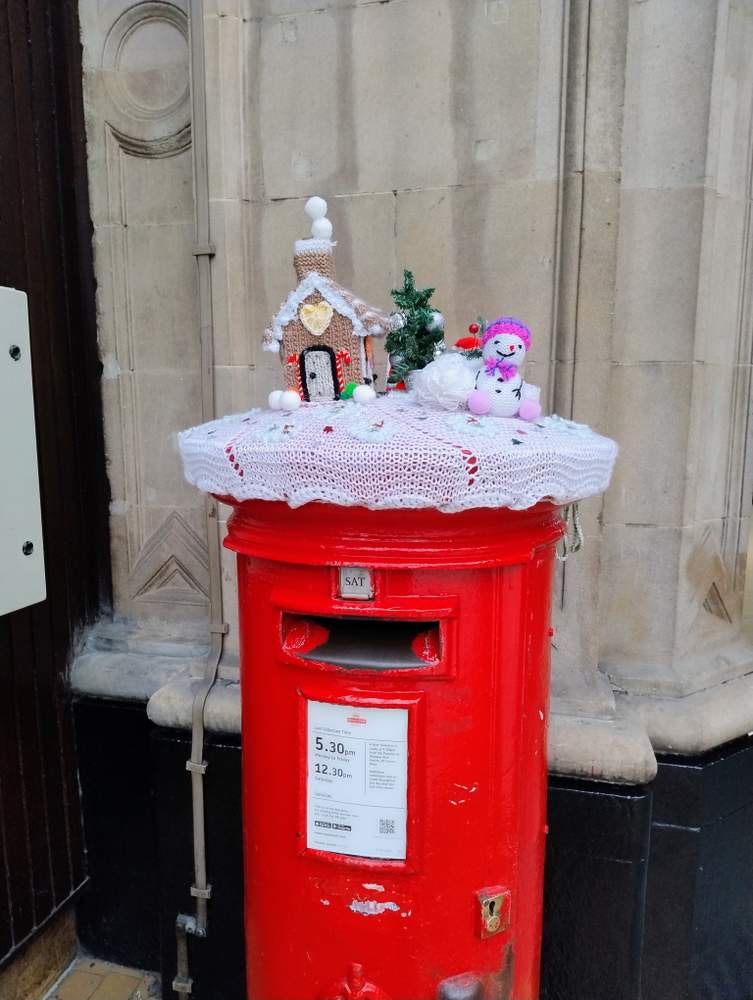
Passing through Glasgow Central train station a few days ago, my partner and I spotted this ridiculousness on top of a post box. When I put a photo of it onto social media, replies poured in from across the UK: “YES! We have them here too!” It’s called yarn bombing, and it seems to have started in the U.S. a few decades ago as an attempt to brighten up gloomy urban spaces, in much the same way as guerrilla gardening or the best kinds of street art. (Another name for yarn bombing is kniffiti. So great.) On living structures, it’s probably a bad idea: constricting growth, tangling up the wildlife, making a mess as the weather makes it fray to pieces. But for bringing a bit of colour back to our most severely monochrome urban spaces, they’re a welcome sight - so I hope knitters across the UK find a way to “hack” the new style of post boxes currently being rolled out, with solar panels blocking where the knitted caps would formerly go. I bet they’ll be up to the challenge. And staying with Glasgow…
A thing I’ve wondered for a while: why aren’t sleeping bags solar-powered? It seems like such a no-brainer for winter hikers: mop up the sun’s energy during the day, plug a battery into your electric-blanketed sleeping bag, spend the night toasty-warm even in the iciest conditions… It turns out this is an idea even a 12 year old could come up with - because this one just did, winning a number of awards in the process. Glasgow electrical engineering firm Thales has now made 30 prototypes and given them out to 6 homeless charities across the city, and it’s currently working on producing another 120 more. It’s a lovely thing to see, because Glasgow has its fair share of rough sleepers and in the winter its streets can be absolutely bitter Meanwhile, Loughborough alumni Sri Hollema won an award this year for her business Mat Zero, which makes solar-powered sleeping mats - so there’s plenty happening for the benefit of outdoorsy hobbyists like me as well. How absolutely grand. And speaking of warm glows:
Before this month, the first conclusive signs of human beings creating fire with stone handaxes were from around 50,000 years ago, from archaeological sites in France. Then this report from a palaeolithic site in the east of England was published in Nature on the 10th December - and that date leap backwards an absolutely staggering 350,000 years. Putting that into context, that’s longer than we’ve existed as a distinct species (Homo sapiens). The primates wielding fire in this discovery were early members of the now-extinct species Homo neanderthalensis - our direct ancestors only via interbreeding. To be clear, this certainly isn’t the first evidence that suggests the intentional use of fire by humans - there’s evidence of controlled burning that goes back at least a million years - but this is the first evidence that clearly points to fire-making, using specific tools, which, in the words of Prof Chris Stringer of the Natural History Museum, “made [early humans] more adaptable, enlarged the range of environments they could survive in, and helped catalyse the evolution of social complexity, brain growth and probably even language itself." The multimedia BBC article on it is an absolute treat, so please do check it out. Finally: a planet shaped like a what?
Having spent my entire adult life assuming the world “planet” always means “spherical” (my insincere apologies to Flat Earthers), it’s a touch discombobulating to realise other planet shapes can exist - as with the exoplanet PSR J2322-2650b, which seems to have one pointed end, like an egg. The reason is its proximity to a pulsar - a dense, highly magnetised spinning corpse of a former star. With just one million miles between exoplanet and pulsar, the gravity of the latter is tugging the former into its bizarre shape, somehow all without ripping it to shreds:
Even more surprisingly, its atmosphere seems to be filled with molecular carbon, binding mostly to itself instead of forming other carbon-containing compounds - and in the words of Margherita Bassi at Smithsonian, this suggests the presence of “floating soot clouds that can condense and turn into diamonds”. How this can even happen is currently a mystery. In short: the more astronomers look at the wider universe, the weirder things seem to get. If you’re looking for the right metaphor to take you into 2026, I reckon that one’s a winner. Images: GiveMeASign; Kreisson Lisungi; NASA, ESA, CSA, Ralf Crawford (STScI).
|