Gatekeepers of Law: Inside the Westlaw and LexisNexis DuopolyEver since a spate of mergers in the 1990s, Westlaw and LexisNexis have dominated legal research. And that might be why searching legal cases is so costly, even in the age of AI.
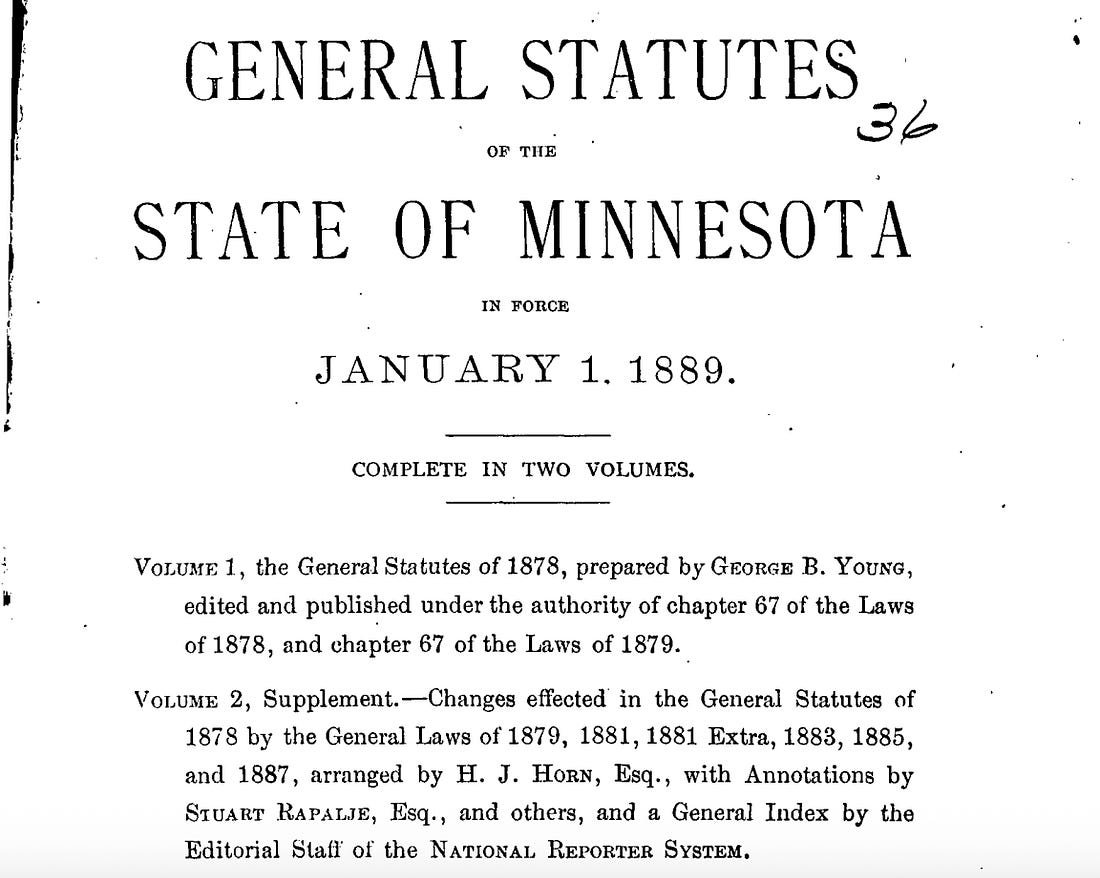
Introduction Hi there! My name is Tom Blakely, I’m a federal judicial law clerk and attorney. I previously worked in big law and the United States Department of Justice. You might remember me from last year, when I wrote about the US v. Google ad tech antitrust trial at Big Tech on Trial. I’m excited to be writing a guest piece for BIG, this time on a particular competition problem I (and nearly every lawyer) deals with on a daily basis: the Lexis/Westlaw duopoly. The law in America does not belong to lawyers, it belongs to all of us. As citizens, we must be able to read the law, understand it, obey it, and bring complaints against those who wrong us. That is the basis for a coherent political order, and why the rule of law is such a foundational aspect of a democratic system. Moreover, it would be hard to find a technological era more suited to the democratization of law than the one we’re in today. The computer lets anyone query instantly, the internet lets anyone do it from anywhere, and generative artificial intelligence can decipher and explain complex legal questions if it has access to credible databases. And yet, today, two powerful companies dominate and restrain access to key aspects of our legal order, from case opinions to legislative history. To give you a sense of what I mean, Lexis, one of two dominant legal research platforms, charges up to $469 for a single search. That’s the equivalent of a Google query, for almost $500. Moreover, beyond LexisNexis and its rival Westlaw, the Federal judiciary itself has used its privileged position to charge high fees for court records that should be available to all. Today, the law is hidden behind paywalls. But it wasn’t always this way. In this piece, I’m going to explain how and why America keeps the law from its citizens, and what we can do about it. The Origins of Legal Research The stereotype of a lawyer’s office was traditionally that of a well-manicured desk, with ornate and intimidating shelves of books somewhere in the background. And there’s a reason for the imagined massive quantity of books. The practice of law in the United States relies on them. We use a system that came from England, called the common law tradition. In that system, there is the legal rule that is written down, known as statute. But then there is also a lot of interpretation of that statute, through cases. And those interpretations are often binding. To know what the law is beyond what statutes say, you must research the case law. U.S. federal courts publish cases in “Federal Reporters” and each case is identified by a case cite. An example of what this looks like would be “United States v. Alcoa, 148 F.2d 416 (2d Cir. 1945).” Prior to today’s day and age, to read this case, you would have to physically go to a law library, find the 148th print volume of the 2nd Series of the Federal Reporter (what the “148 F.2d” stands for) on the shelf, and turn to the 416th page to read the 1945 opinion of the United States Court of Appeals for the Second Circuit in United States v. Aluminum Co. of America (Alcoa). It is a cumbersome if necessary system, and the early companies in the space made it easier to manage. In the late 1800s, the West Publishing Company was founded to meet the pressing need in the American legal profession for timely and accessible print compilations of the latest court decisions. In the early days of West, courts produced typewritten and printed slip opinions that would be made available to the company and the public in limited supply and through a patchwork of processes that varied greatly from court to court. Some courts hired people whose job it was to report opinions. Others did not. Some judges even tried to keep track of their prior opinions on their own. West responded to this problem by collecting and publishing opinions in bound volumes, originally only in Minnesota state courts but eventually expanding to courts nationwide. When it started its business, West would first provide advance sheets and slip opinions, printed initially in paperback. West would then format and collate them by adding syllabi, headnotes, and its proprietary system of page numbers and distribute them through the reporters it published and sold throughout the country. Over time, West developed two complementary systems that would become the foundation of the legal information industry for the next century: the National Reporter System and the Key Number system. The National Reporter System (NRS) is comprised of regionally organized reporters covering published decisions across state and federal courts. The NRS created a comprehensive, privately operated official reference system that lawyers and courts could cite to uniformly, across all U.S. jurisdictions. Some jurisdictions entered into contracts with West to be their official publisher.
West’s Key Number System on the other hand, was curated by West’s attorney-editors, who summarized and organized key legal points and opinions into headnotes, assigned them a topic and Key Number, and then compiled these headnotes into digests. This system gave West a sort of taxonomical monopoly over U.S. case law, since all research paths began with West’s system of Key Numbers and pagination, and ended in its reporters. West also published Black’s Law Dictionary and the “U.S. Code Annotated” (USCA). The USCA, much like West’s case law, was essentially a copy of all federal statutes on the books with annotations added, organized and formatted into bound volumes that West sold. But throughout most of the 1900s, West was not the only participant in the market for legal information. The Shephard’s Company was a critical provider of citation services. Shephard’s offered lawyers time saving lists of cases citing to prior case law, so they could easily and quickly determine if decisions had been overturned or affirmed later on down the line. The term “Shephardization,” which is the process of analyzing what case law is still “good law” by reviewing later judicial treatments of prior decisions, got its name from that firm. In addition, The Michie Company was a leading publisher of state law, and Matthew Bender published famed legal treatises like Collier on Bankruptcy and Moore’s Federal Practice. Lawyers Cooperative Publishing was another keystone of the “secondary” market, producing secondary source titles like American Jurisprudence, which synthesized various areas of the law for practitioners. Other market participants, like Callaghan & Company, Clark Boardman, and Bancroft Whitney, provided specialty treatises or focused on certain jurisdictions. Research Institute of America (RIA) was another such publisher, focusing on tax, auditing, and finance. Commerce Clearinghouse (commonly known as CCH) specialized in the niche of labor and regulatory law. American Law Reports (ALR) were popular, high-quality, and in-depth reference articles on various legal topics, and were another institution of 20th century legal publishing. All of these, with the exception of CCH (which would later be acquired by Dutch information services giant Wolters Kluwer) would eventually get acquired by West. The Computer Age Changes the Game In 1977, there were about 23 legal publishers of considerable size, each separately owned. In the 1970s, universities, the government, and large organizations were beginning to use computers more widely. Law libraries were becoming burdened with cumbersome case texts that rapidly became obsolete with the passage of time, as new case law was created and old case law was overturned or supplanted. Mead Data Central, an Ohio company, saw a system ripe for technological innovation. The company launched Lexis, which put serialized case texts into a searchable electronic database. As the first computer-operated legal research system, Lexis changed the game. West created its own computer service, Westlaw, shortly after. Meanwhile, The Thomson Corporation, a large Canadian publisher, began buying up an extensive series of smaller publishers in the late 1970s—few of whom are recognizable household names. But Thomson, which had been founded as a newspaper company but had been moving aggressively into the business information industry of the day, had built itself into a powerhouse that directly competed with West. West and Thomson published the only two comprehensive legal encyclopedias, the only two prominent legal dictionaries, and the two most important insurance law treatises. Thomson also held official state reporter contracts that were more limited than West’s, including with California, Washington, and Wisconsin. Lexis actually licensed content from Thomson in order to compete against West in the electronic legal research market that Lexis had pioneered. West’s Page Number Monopoly Erodes and an M&A Spree Begins Lexis and Westlaw came into legal conflict in the 1980s—over Lexis’ appropriation of West’s vaunted page number system. Page numbers are the heart and soul of legal citation, and up until the end of the 20th century, comprised much of the engine of West’s business model. While court cases are technically in the public domain, by presiding over the National Reporter System and its proprietary page numbers, in an industry that runs on precise citation to authority, West had effectively built a moat around itself. While theoretically anyone could mass publish court opinions, without West’s authoritative page numbers, any such reporter would be mostly useless. Prior to 1991, U.S. copyright law actually held that West’s business of putting page numbers over compendiums of public domain court cases was eligible for copyright protection, and that Lexis, by using West’s page numbers, had committed copyright infringement. It seems strange today to think that merely adding page numbers and minor edits to public records was sufficient to create a work eligible for copyright protection, but this was the law of the land at the time. Pagination presented an enormous source of leverage for West. Because the Bluebook (the citation stylebook for lawyers), court rules, and nearly all fora of legal writing require keyed pinpoint citations to page numbers in official reporters (in other words, West’s reporters), West had the market cornered. But after the Supreme Court’s decision in Feist Publications, Inc. v. Rural Telephone Service Co., in 1991, which found that merely publishing compilations of non-original records (in that case phone books but in West’s case, court cases) is not protected by copyright, the United States District Court for the Southern District of New York would later hold, applying Feist, that the changes West made to the cases it compiled were “trivial” under the Feist standard, and therefore no longer subject to copyright protection. Two former competitors to West, Matthew Bender (discussed above) and HyperLaw (an early entrant in the market for legal technology that produced CD-ROMs of court cases) brought suit against West. The Second Circuit ruled in November 1998 that West’s page numbers “did not entail even a modicum of creativity” and as such were fair game for rivals to cross-reference. This is key for many reasons. As the quasi-official publisher of American judicial opinions, West’s page numbering, at least to a certain extent, was as much of its business as the ho-hum task of compiling and printing the decisions themselves. If competitors could reference West’s page numbers, it represented a substantial loss of a main proprietary component of West’s business model. It is also key as the timing of the Feist decision coincided with the commencement of, as detailed below, a decade of mergers and acquisitions that, by the 2000s, would leave two main market participants left standing—Westlaw and Lexis. The 1991 Feist ruling was the starting gun. In 1994, Reed Elsevier, a British information services conglomerate, beat out Thomson to acquire Lexis and its parent company. Thomson then moved on to seeking to acquire West, kicking off an extraordinary wave of mergers and acquisitions that is breathtaking not only for the scale of consolidation that occurred, but gory political machinations surrounding it. The Thomson-West Acquisition is Allowed Under a Cloud of Corruption and the Lexis-West Duopoly is Born These facts are primarily reported in (and adapted below from) the 2009 book “Free the Market!: Why Only Government Can Keep the Marketplace Competitive” by Gary Reback, a famed antitrust litigator well known for his role in spearheading the efforts that lead to the antitrust suit against Microsoft in the 1990s, and who also represented Lexis at the time. Thomson’s proposed acquisition of West prompted outrage, with state bar associations, news outlets, law librarians, and public interest groups sounding the alarm on how the inevitable and astronomical increase in legal research fees that would ensue would raise the cost of legal services. Despite the antitrust problem of one company buying its only significant publishing competitor, and despite Reback’s zealous advocacy on behalf of Lexis, the deal somehow sailed through the Justice Department without challenge. Reback explains in his book that using nearly any approach to analyze the anticompetitive effects of the proposed Thomson/West acquisition that was allowed by the then current DOJ/FTC merger guidelines would have condemned the tie up. In other words, on the merits, there is simply no way this merger should have gone through. Reback details receiving a call one morning from a CNN reporter, seeking his comment on a story they were working on, that the former owner of West pledged more than $150,000 in campaign contributions to Democrats while the Thomson deal was pending approval from Bill Clinton’s Justice Department. One does not need to be much of a cynic to connect the dots between these backroom political dealings on the one hand, and how the merger seemed to glide through regulators—against the balance of the law—on the other. Reback goes on:
To satisfy antitrust enforcers of the day, and get the West-Thomson deal across the finish line, Thomson merely had to offer to sell an agreed list of its publications, and license the use of West’s page numbering to other companies, which realistically meant only Lexis. No small publisher or other prospective market participant could afford the rates. In fact, the agreed sale of the electronic citation tool Thomson used was made to none other than Lexis, entrenching the Lexis/Westlaw duopoly for years to come. As Reback writes:
For Lexis to remain competitive, it necessarily had to bring about its own secondary wave of consolidation, buying up many smaller companies to grow and survive against the new Thomson-West leviathan. The Justice Department, per Reback’s telling, allowed this secondary wave of consolidation as well. Lexis’ new owner, Reed-Elsevier, acquired state court case publisher The Michie Company, mentioned earlier. Lexis also rolled up Shephard’s Citation Service, and Dutch publishing giant Wolters Kluwer absorbed CCH Inc., who was a provider of tax and business law information, software and services. And with that, the market for legal research consolidated immensely, down to just two market participants—Westlaw and Lexis. Reback writes in his book that:
Higher Costs and a Dearth of Innovation Follows in the Decades Since In the 30 years since, while Lexis and Westlaw might have glossier looking websites and the internet might load faster than it did back then, the market for legal research services is not much different than the one Reback and others warned about in the 1990s. The lack of competition facing the Lexis/Westlaw duopoly has removed pressure for these firms to innovate their product offerings or prices. To simply search for cases (which are public records), a small law firm with only 10 attorneys can expect to pay around $2,100 per month for Westlaw. Lexis meanwhile charges $1163 per month for just 3 attorneys for its “Professional” plan. Organizations of larger size (so most organizations) must individually contact the sales departments of these companies for black box pricing which is orders of magnitude higher. Indeed, trying to reconcile any kind of “ballpark” number for what using these services ultimately cost in the course of legal practice is all but impossible. Certain kinds of searches and documents present a broad array of hidden upcharges and widely varying fees. As I noted above, Lexis charges up to $469 for a single search. Lexis also publishes discount rates for monthly search bills of up to $180,000. We’re talking about bills of nearly $200k per month (!) just for searching public domain court cases. There are also quality issues. Lexis and Westlaw still require wonky and outdated search operators that were last in regular use by search engines at the time of these services’ inception, are not nearly as intelligent or predictive as other search services, and no serious competitor has ever emerged. And what of generative AI? These companies only recently rolled out rudimentary AI tools. On this count, I have used both ChatGPT and Lexis’ AI tool. They are mediocre for legal research at best. For one, ChatGPT does not have access (by design) to Lexis and West’s ocean of case law straight from the courts. Lacking access to legal cases that are putatively considered to be in the public domain, but in reality are locked firmly behind Lexis and West’s paid research systems, Large Language Models cannot discover them the way they do with other information, and AI frequently “hallucinates”—plugging the gaps with made up cases that do not exist—to disastrous results. Even Lexis and West’s own AI tools struggle to make more-than-basic levels of inferences about whether or not a case helps answer your question, beyond the fact it includes relevant keywords. PACER—the Federal Government’s Docket Monopoly Is a Problem, Too This brings me to my last point: the government’s role. As a law clerk to a federal judge, I have access to the full suite of not only research services, but powerful tools the federal courts use to manage cases. As my colleague Lee Hepner has pointed out, the government’s own case tools, chiefly PACER (standing for “Public Access to Court Electronic Records”) have long been sclerotic, antiquated, and overpriced. PACER is used to access full case dockets (to view motions, orders, and filings, not just the judicial opinions you find on Westlaw and Lexis.) CM/ECF (standing for Case Management/Electronic Case Files) is similar to PACER but is used by attorneys to file materials with courts. The U.S. government—specifically the federal judiciary, manages PACER and CM/ECF. In addition to PACER’s ancient interface (here is the link to see the D.C. District Court’s PACER page for yourself) it has security problems, which were highlighted recently when it was apparently hacked by Russia, compromising sealed documents. Its costs are also outrageous. PACER is a somewhat rare example of a government monopoly—where instead of a sole private corporation controlling a market to ill effects, the government does. Usually, that makes sense after all. The government has a monopoly per se on many things, like criminal prosecution, military forces, road improvement, etc. But what’s unique in this case is the federal government is using its position as a monopolist over access to dockets to extract monopoly rents. The fees the federal government charges for court documents are significant. PACER charges users $0.10 for every page users search and access, and $30 per name or item searched plus $0.10 per page per document per month, albeit with a max of $3 per individual document. While to some, these might not seem like large numbers, consider the fact filings are hundreds of pages long, there can be numerous documents per ECF docket entry, hundreds of entries per docket, and infinite dockets to browse. If you do not know exactly what ECF number and case you are looking for, and you need to browse more than a handful of pages, these fees add up quickly every month, particularly for those not at big law firms with large corporate clients who can foot the bill. Conclusion Unlike most competition problems, this one is unique in that the government is in fact the source of the goods in the market (i.e. courts produce the opinions and orders that are then given to Lexis and Westlaw to publish). As such, the government has tremendous leverage over the companies and the ability to fix the problem, much like the Justice Department once tried to do with its JURIS service before shuttering it in the 1990s in favor of a contract with West. By making case law freely accessible to anyone, insurmountable barriers to entry would be removed, and new market entrants could create far more cost effective and innovative solutions than what Lexis and Westlaw offer. An example of one such site that tries to do this is Justia. But Justia, while often useful for finding the texts of certain higher profile judicial opinions, suffers from the problem of not having access to anywhere near the inventory of opinions that the Lexis/Westlaw duopoly does. As a result, it functions more like a repository of select opinions, not a fulsome legal search engine that helps you answer questions, discover case law, and conduct legal research, and as such, it is not a viable competitor. So beyond the obvious dump trucks of lobbying cash Lexis and Westlaw would throw at preventing any such solution, in a similar way to how tax prep companies lobby against a free online IRS tax prep tool for the public, what are the obstacles? Well for one, this issue is just not attractive to elected officials. It’s boring, non-ideological, won’t grab many headlines in mainstream media, and it doesn’t affect those outside the relatively narrow legal industry in the way another competition problem, like Live Nation/Ticketmaster does for example. But what if it has a bigger impact than we realize? By inflating research costs (a significant source of overhead) for lawyers, legal services cost the public more money. Those who can’t afford big legal bills are forced to either forgo access to justice (along with their rights) or go with lower caliber legal services. Moreover, transparency is reduced, as while trials and the records they produce are putatively considered open to the public, if you don’t have monopoly money to pay to access them, they simply are not. Opening case records to the public domain for free—like the vast majority of public government records—would allow new competitors to Lexis and Westlaw to create innovation and lower costs. This, in turn, would reduce expenses for legal organizations (significantly helping public interest and legal aid groups), improve access to justice and transparency, and allow for a better-functioning legal system—with higher-quality legal representation for all. At least in theory, this is the case. But like solving nearly any antitrust problem, the market cannot be fixed overnight. While the competition problem in this market is undeniable, it would take time for the competitive landscape, innovation, and prices to improve. Taking a crowbar to the Lexis/Westlaw duopoly however, is the first step, and an important one. Thanks for reading! Your tips make this newsletter what it is, so please send me tips on weird monopolies, stories I’ve missed, or other thoughts. And if you liked this issue of BIG, you can sign up here for more issues, a newsletter on how to restore fair commerce, innovation, and democracy. Consider becoming a paying subscriber to support this work, or if you are a paying subscriber, giving a gift subscription to a friend, colleague, or family member. If you really liked it, read my book, Goliath: The 100-Year War Between Monopoly Power and Democracy. cheers, Matt Stoller
This is a free post of BIG by Matt Stoller. If you liked it, please sign up to support this newsletter so I can do in-depth writing that holds power to account.
|