Monopoly Round-Up: A Gunboat Oligarchy Goes After Venezuelan OilTrump kicked off 2026 with a military attack on Venezuela and a naked seizure of oil resources. Wall Street is overjoyed. Plus, Mamdani takes office and billionaires rage at a wealth tax.
Ok, so I was going to do a year end review and predictions issue today for the anti-monopoly movement, but yesterday, the U.S. engaged in regime change in Venezuela. At the end of this post, I’ll have the usual monopoly round-up, with lots of news. But we’ll start with the situation in Venezuela, about which Wall Street is very excited.
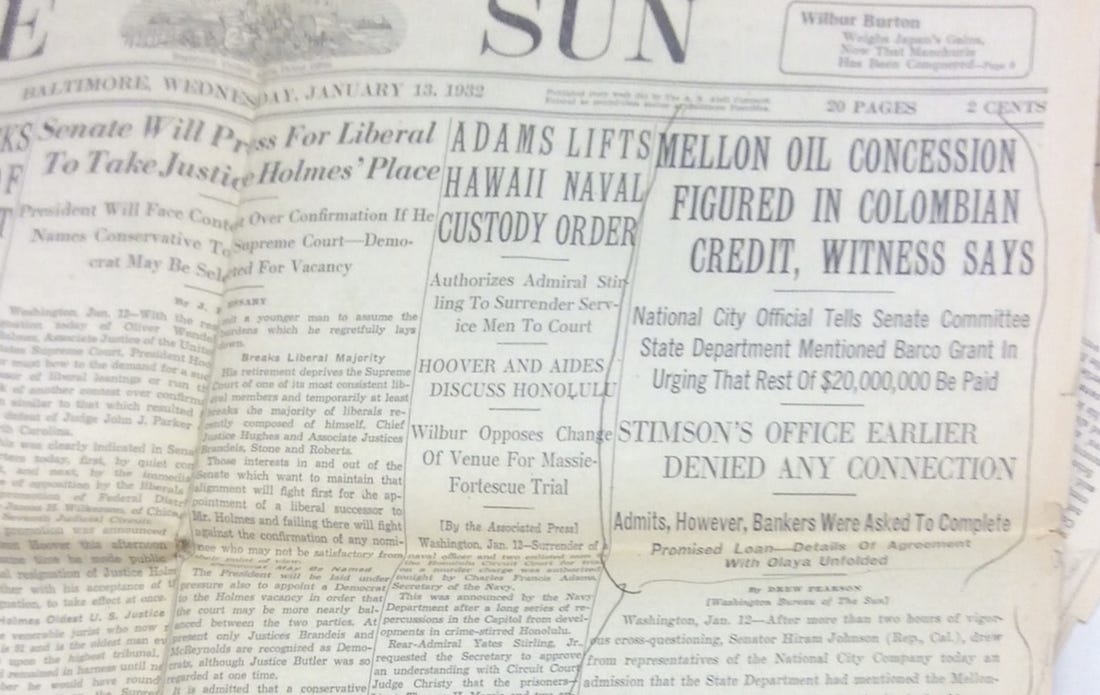
The best way to understand what just happened is to start with history. Because while Trump is unusually explicit about his rationalization for seizing control over a resource-rich territory, U.S. domination of the oil reserves of South America is not new. And neither is the fusion of corporate and state interest. Ninety five years ago, in 1931, Treasury Secretary Andrew Mellon, who owned Gulf Oil (now Chevron), forced the President of Colombia to give his company the Barco oil concession, which borders Venezuela. How? Well Wall Street banks and the U.S. government threatened to withhold vitally needed bank loans if Colombia did not cede the franchise.
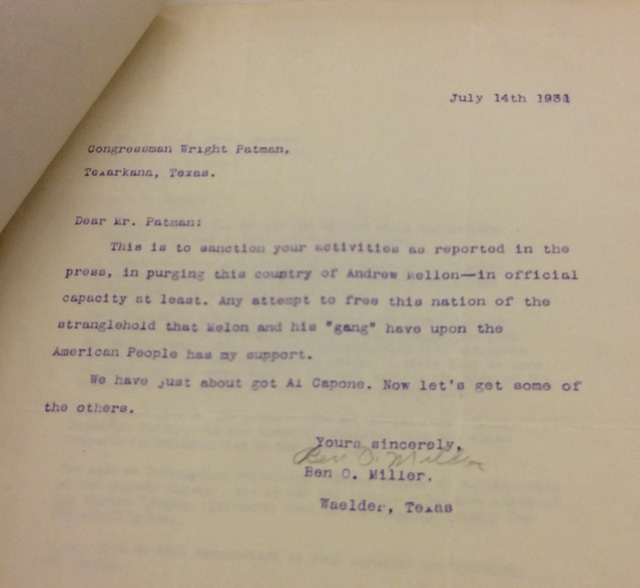
The parallels to the situation today are there. When Mellon seized these reserves, in partnership with JP Morgan banking interests, gunboat diplomacy was the norm. In the prior two decades, the U.S. had finished brutally putting down a resistance movement in the Philippines, and had become the global economic and political power after a gruesome world war. Woodrow Wilson had tried to establish a global rules-based order, which the GOP in the 1920s sabotaged. At the time, Democrats were incompetent and split, as it was an era of deep reverence for the wealthy and bitter culture warring over race and alcohol. For instance, the head of the DNC in the late 1920s, a Dupont executive named John J. Raskob, published a pamphlet titled “Everybody Ought to Be Rich” encouraging Americans to borrow money to invest in the stock market. Just as there is increasing support for cynical and nihilistic figures today, many in the 1920s felt warmly towards Mellon, Mussolini, and authoritarianism in general. U.S. Steel chairman Judge Elbert Gary encouraged Americans to “learn something by the movement which has taken place in Italy,” while progressive and New Republic founder Herbert Croly called Mussolini as substituting “purposive behavior for drifting and visions of a great future for collective pettiness and discouragement.” Gunboat diplomacy fit in well. To be sure, there were opponents of Mellon and the super-wealthy, like New York Governor Franklin Delano Roosevelt, Tennessee populist Cordell Hull, as well as a Congressman elected in 1928 from Texarkana, Wright Patman. In 1929, Patman sought to impeach Mellon over self-dealing and bad stewardship of the Federal Reserve. But this crusade was seen as quixotic and absurd. “It has been said that it is hard to convict a million dollars in the criminal courts,” said Patman. “It can also be said that it will be hard to impeach a billion dollars.” It was a time of intense disillusionment, of short-termism, when Americans sought to bury the pain of betrayal of democracy in speculation, fraud and greed. But then came the 1929 crash, and a period of “debunking” of myths, as Louis Brandeis put it. The old order was discredited. And a political realignment occurred. The Democrats turned to liberalism, and former party elites like Raskob became bitter foes of FDR in the 1930s. But more importantly, Patman’s impeachment campaign succeeded. Mellon was fired, because then-President Herbert Hoover was under political pressure over the widespread revulsion towards economic elites. You get a sense of this dynamic by going through Patman’s Congressional correspondence. “We have just got Al Capone,” wrote one Texan. “Now let’s get some of the others.”
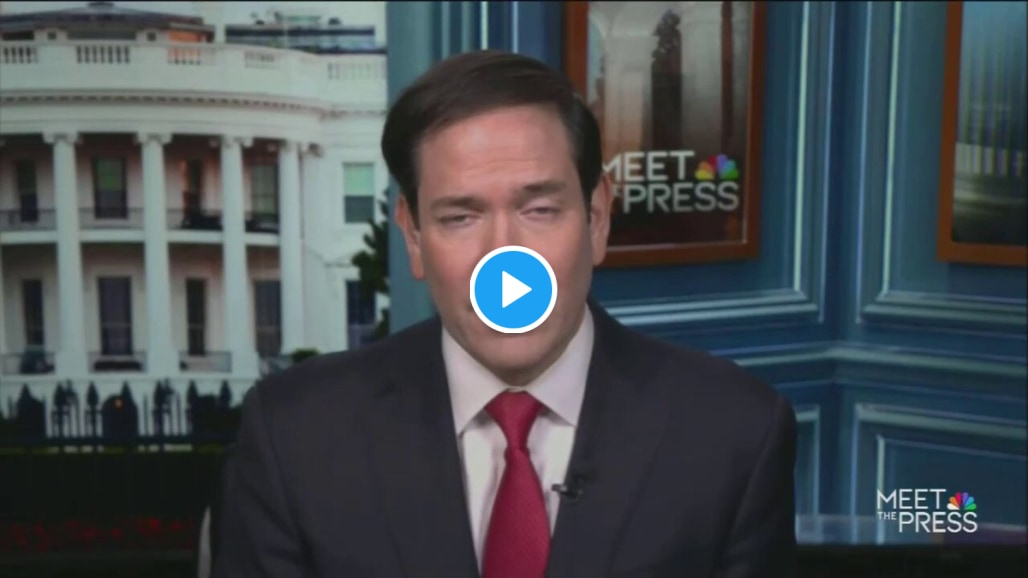
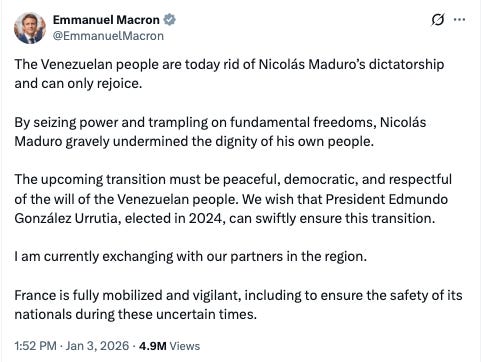
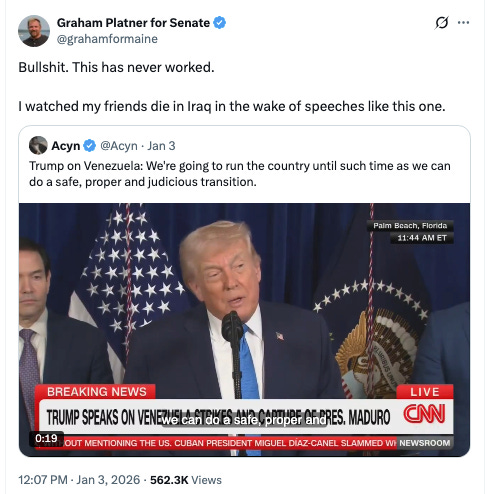
And that brings us to today. Donald Trump’s Venezuela AdventureOver the past few months, the U.S. put more naval firepower in the Caribbean than was massed for any maritime operation this century, with the goal of toppling the government and installing someone more favorable to U.S. interests. Then, yesterday, a special forces team captured President Nicolás Maduro and brought him to New York City, where he was charged with drug trafficking crimes. Why? Well, to hear President Donald Trump tell it, the goal was to capture control of Venezuelan oil. Wall Street hedge funds and energy investors are already on their way to the country, and Trump has said that large U.S. oil companies will control these natural resources. There’s a greater rationale at play, which is that Trump wants everyone to know he kicks ass. He has, for instance, also threatened Cuba, Mexico, and Columbia with similar military actions, and Iranian leaders are panicking. Here’s Secretary of State Marco Rubio laying out a rationale for attacking Cuba. Ultimately, what the attack on Venezuela shows is that Donald Trump decided to use his 2024 mandate for change to revert back to a traditional gunboat diplomacy framework, both domestically and abroad. Like Mellon, Harding, Hoover, and George W. Bush, Trump is operating on behalf of financial capital. Indeed, Trump more reflects Bush than anyone else; his administration is staffed with former Bush Republicans, and the GOP Congress is full of Bush adherents. On the international front, Trump has green-lit regime change as a strategy in oil-rich countries, from Iran to Venezuela. On the domestic front, he has pursued policies friendly to cryptocurrency and private equity, both echoes of deregulation. He pardoned white collar criminals and has rolled back white collar enforcement. In terms of China, he has conceded to Xi Jinping in most important respects so as to please Wall Street, which is what Bush did. And on mergers, we’re in a historic merger boom. Even the Trump tariffs are much less than meets the eye. The closer you look into it, the more the Venezuela operation seems to be a result of orthodox U.S. policy and not merely Trump’s whim. A large chunk of the global establishment likes what just happened. For instance, the President of France Emmanuel Macron, hardly a Trump fan, is supportive.
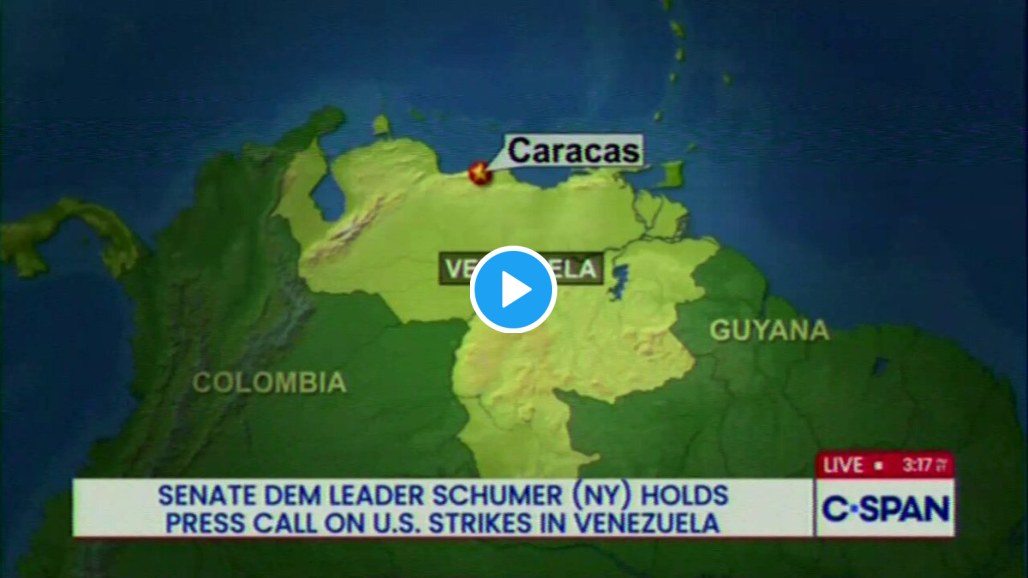
Domestically, while a lot of Democrats have expressed opposition, the Democratic leadership, Chuck Schumer and Hakeem Jeffries, are largely silent, or characterize their objections in terms of them not being notified of the attack. It’s a very 1920s style of opposition party fecklessness.
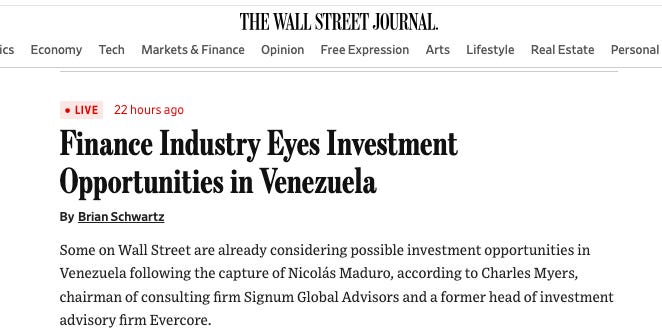
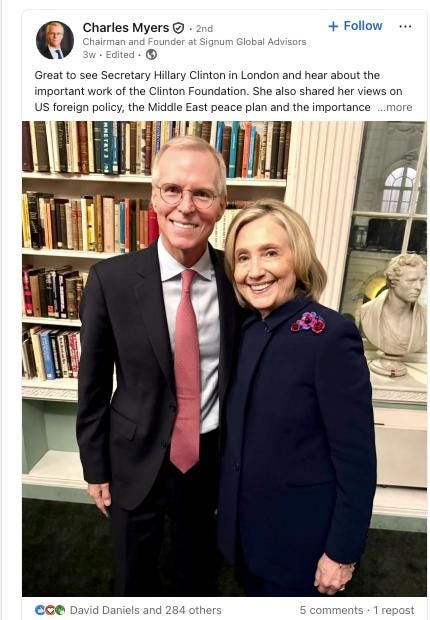
There’s even continuity with the last administration. In January, the Biden administration put out a $25 million reward for Maduro on drug trafficking charges, so it’s not like regime change sits outside of the foreign policy consensus. And big Wall Street donors to Democrats, like Signum’s Charles Myers, are using the invasion to drum up business for investing in an occupied Venezuela. It’s comically similar to the Hoover and Bush eras. Here’s a LinkedIn post from Myers just three days ago.
There are differences between the current moment, the 1920s, or the early 2000s. An obvious one is that Mellon and Bush tried to deny what they were doing was about oil, while Trump isn’t hiding it. Another change since the 1920s is the rise of aristocratic Venezuelan and Cuban constituent diasporas inside the United States, who successfully lobby to use U.S. resources to intervene in their home countries. It’s a class war, where Spanish-descended aristocrats are fighting the working class. The biggest difference, I suspect, is that the U.S. has de-industrialized in favor of China. While Mellon ran his mines with machine guns and his factories with brutality, his productive assets were inside America. He did not organize his businesses to be “capital light” nor did he offshore most work, because it simply wasn’t possible to do so. When Bush attacked Iraq, the U.S. had a robust and diverse industrial base. But today, China is the world’s factory. A line often put to Napoleon Bonaparte characterizes the situation quite well: “Let China sleep, for when she wakes, she will shake the world.” Well that nation is now awake, U.S. power is ebbing, and the rest of the world can see it very clearly. Our ability to dominate the next wave of warfare is in serious question. The U.S. can’t even produce missiles without samarium, a rare earth metal almost totally controlled by China. We’re not good at making things anymore, and we’re barely even trying, so dominated are we by lazy financiers. We can also observe that Chinese industrial policy has delivered a manufacturing near-monopoly, with world-class products being churned out and undercutting everyone else through a mix of smart policy and predatory means. But I think in one important respect, Trump’s approach has important parallels to Mellon. Mellon’s approach collapsed in the face of tremendous public rage, both over his foreign affairs and domestic incompetence. And it didn’t just discredit Mellon, but brought an entire social hierarchy down. Though the U.S. is not in anything like a depression today, most people feel ripped off and frightened. In that sense, we are already into the ‘debunking’ phase that Brandeis discussed. The Case for OptimismA few weeks ago, I wrote about my reasons for optimism for the coming year. It’s not that the institutions or news will get better, indeed things are going to get a lot worse. Believe it or not, I had military action in Venezuela on my list of predictions that I had planned to write today. Another attack on Iran is also likely, as is a massive consolidation of political and economic power. So why the happy face? Well, it’s that the public is finally cottoning on to the real power structure they inhabit, after a 50-year episode of amnesia. There is now deep and broad popular anger at the makers of war, and oligarchs. In 2009, the Democratic Party had the credibility to contain this rage, but no longer. There are already mass protests against this Venezuela regime change, even though it’s not yet particularly bloody. “I’m 37 and grew up with the Iraq wars,” said Katrina Denny. “This morning, I was like, ‘Oh my God, we’re doing it again.’” When Zohran Mamdani won the mayoral contest in New York City, he showed that the Democratic establishment is weak. And new types of candidates are emerging, who have a Patman-esque vibe, and who may seek to re-introduce the “good neighbor” policy that FDR eventually used to supplant Mellon-esque gunboat diplomacy in South America.
We are in a world where American hegemony is both in decline and openly predatory. There is no return to the “rules-based international order,” whatever that means. And that means we’re going to go through a very high-stakes and very creative period. It could mean reform, collapse, crisis, or realignment, it will likely have elements of all four. But at least the public is open to considering new points of view. That may not sound like much, but it is far more important than most believe. As Abraham Lincoln put it in 1862, “The occasion is piled high with difficulty, and we must rise with the occasion. As our case is new, so we must think anew and act anew. We must disenthrall ourselves, and then we shall save our country.” And now, the monopoly round-up. The most important news is New York City Mayor Zohran Mamdani’s initial moves, which suggest he is actually serious about addressing concentrations of economic power. Plus, a proposed billionaire tax in California is part of a new attempt to bring down the unfair return on capital in America, and is driving the superrich to say some insane stuff. Also I found a cool story about how a toy designer ended up as the architect of the moon rover, in case anyone doubts the importance of ‘low’ value manufacturing. All after the paywall…... Continue reading this post for free in the Substack app
|