Welcome back to the Curious About Everything Newsletter! CAE 57 is here, if you missed it. The most popular link from last month was Ellen Scherr’s piece about aging out of fucks to give. My updates
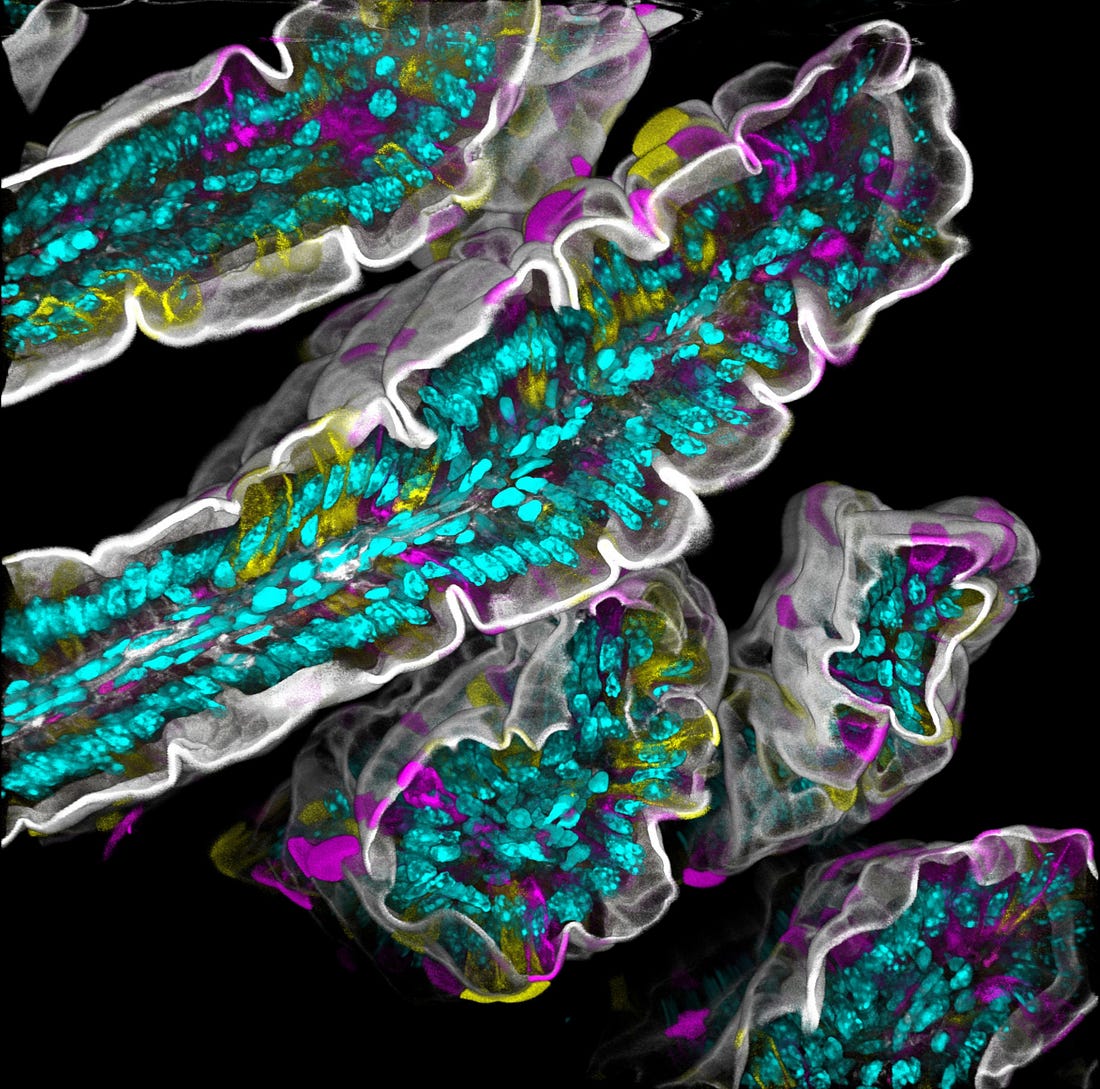
Featured art for CAE 58CAE 57’s featured artist is Rebecca Lee, whose beautiful microphotography image below was an honourable mention in this year’s Nikon Small World competition. Taken at 40X, it features villi from the small intestine of mice. The image is not only lovely on its own merits, but a part of the body I know well: villi are affected in celiac disease (among other conditions), and I was diagnosed celiac decades ago and quickly learned to respect them. See Rebecca’s Instagram for her sketches, and see the Nikon link below for more microphotography.
The most interesting things I read this monthWant to help keep CAE free? The best way to do so is to become a member of my Patreon, where I also share overflow CAE links. Patreon memberships provide me with stable income so I can keep offering CAE without a paywall. Use code NEWYEAR26 for 15% off annual subscriptions — it’s valid through the end of January. Start with some end of year lists:Start here for year-end roundups I feature annually, or simply enjoyed. Then fill up your browser tabs with the pieces below. There are no “Quick Links” this month because of these year end lists, but the QL section will be back next month!
Thanks for reading ♥ Subscribe to receive next month’s Curious About Everything—it’s free! The rest of the most interesting things I read this month:🛷 Ottawa man takes his Uber driver tobogganing for first time. Loved this feel-good story from my city of Ottawa, where passenger Dave Nguyen discovered his Uber driver, Chance Niyomugabo, had never been tobogganing. He then sought to fix that problem and take Chance for a whirl down a hill in Kanata. Ottawa Citizen 🚰 My Sparkling and Surreal Experience As a Water-Tasting Judge. Canadian publication The Walrus was an unexpected place to find a profile on the (surprisingly) competitive world of water tasting, but the annual competition is international after all. The Berkeley Springs International Water Tasting competition is a “gathering place for the world’s most passionate drinking water enthusiasts”. TIL that there is, in fact, a competition dubbed the Oscars of Water. Over the years, dozens of countries have competed in different categories (both carbonated and not), including what is described as “perhaps most coveted of all”, Municipal water. This tasting competition is sampled blind and evaluated the way we evaluate wine, with categories like clarity, aroma (um?), mouthfeel, and taste. Reigning supreme this time in the Municipal category was tap water from Emporia, Kansas, though there were notable samples from West Virginia, North Dakota, and California as well. Attending were water companies and employees from local water utility companies, and also superfans. Markets in everything, I guess? I took tap water for granted until I travelled to places where it was not drinkable, and it made me appreciate the ubiquity of safe water in my hometown of Montreal. Adrian Ma, who wrote this piece, says he recently came to realize he knows “embarrassingly little” about how water is made safe to drink and gets to our homes. So he started reading, found this event, and ended up attending as a judge. Great blend of first person narrative with an important discussion about water safety, including about Canada — whose water samples didn’t make it to the top 3 in any category. Highly enjoyable! The Walrus🚰 ‼️ Scientists Thought Parkinson’s Was in Our Genes. It might be in the water. (Archive link) Yes, we’re still on water, this time about how its contamination can create health crises. For decades, Parkinson’s research has traditionally focused on genetics, but in the last 30 years the disease’s rates in the US have doubled — which is not the way an inherited, genetic disease “behaves”. So what is going on? Newer research estimates that only 10-15% of cases are genetic; the rest are a “functional mystery.” We’ve seen stories about 9/11 frontline workers developing it, thought to be caused by exposure to toxic particles during response and rescue. “The health you enjoy or don’t enjoy today is a function of your environment in the past,” warns Ray Dorsey, a physician and professor of neurology. Amy Lindberg, one of the profiles in this piece, spent 26 years in the Navy and at 57 was diagnosed Parkinson’s. Doctor’s couldn’t tell her why she developed it, and it was a mystery until a study from epidemiologist Sam Goldman compared the health records of two Marine bases, Camp Pendleton and Camp Lejeune. Lejeune’s water source was previously contaminated with “a massive plume of trichlorethylene” (TCE); Pendleton’s was not. When looking at both of the populations from those bases, Goldman found that marines exposed to TCE at Lejeune were 70% more likely to have Parkinson’s than those stationed at Pendleton. Lindberg, it turns out, had spent years living at Camp Lejeune. Great writing and reporting in here. Also, per the piece: TCE was only banned in the US in 2024, and Trump has moved to undo the ban. WIRED Mag 💉 I, who have never stuck a needle in my face. A candid, deeply heartfelt reflection on what it means to live with chronic illness while aging. In looking at societal trends, Erin Nystrom describes the cyclical nature of whatever is de jour, always led by the wealthy. In today’s society, it isn’t the powdered wigs of bygone eras but rather fillers and botox (what she calls “middle-class face augmentation”), mimicking the plastic surgery of the wealthy. As the title suggests, she has not put a needle in her face. Partly, she notes, it’s the cost. But also a tangible decision in protest of how our minds have “been warped to believe that aging is a personal failure”. Instead of valuing women’s wisdom or experience or skills, we value “having the same homogeneous face as everyone else that looks good in a front-facing camera.” And because she doesn’t want to cover up the barometers of health; if she papers over her body with makeup or fillers, she can’t use what it’s telling her as a guide. She argues that these interventions (the fillers, the plastic surgery, the heaps of makeup) only serve to disconnect us further from ourselves, and erase subtle clues in connecting to others. That, in turn, makes us easier to control. It’s a very thoughtful essay, and I agree that beauty and youth are not mutually exclusive. But there’s no question today’s society says that they are. Human, being 🪶 Rapid morphological change in an urban bird due to COVID-19 restrictions. This links out to a study, but one I found really interesting: sheltering in place / lock downs during initial days of Covid provided a natural experiment to test the impacts of human activity on urban-dwelling wildlife. In this case, looking at urban dark-eyed juncos in Los Angeles. We already knew their bill size and shape differed from wild juncos, but scientists measured juncos that hatched before, during, and after the Covid restrictions at a Los Angeles college campus and found that those who were born during or soon after restrictions were put in place had bills that did resemble the wild juncos. Now that restrictions are over, the juncos went back to their urban counterparts. So interesting! PNAS 🐸 Bacterium From Frogs Completely Destroys Colon Cancer. Also on the animal front: whoa! A new paper out of Japan finds that if you introduce specific bacteria (they used multiple strains of bacteria taken from frogs, newts, and lizards) into colon cancer-derived tumours, it kills the cancer cells while also stimulating an immune response in mice. This also gave the mice a lasting immunity against the form of cancer. The three vertebrate species used were two amphibians (Dryophytes japonicus and Cynops pyrrhogaster) and a reptile (Takydromus tachydromoides), and nine strains were used to investigate further. It turns out that one in particular, the bacterium Ewingella americana, isolated from the intestines of Japanese tree frogs (those Dryophytes japonicus mentioned above), possesses remarkably potent anticancer activity. I’ve shared pieces about the gut biome and cancer before, but most papers focus on fecal transplants or other microbiome changes. This one takes a totally different approach by introducing bacteria via IV to attack the tumours themselves. Lifespan.io 📷 2025 Photomicrography Competition. I share the results of this amazing competition annually, because it’s some wondrous photography. It’s also an embodiment of the life I now lead; stuck indoors, the granular is where I find curiosity, and nothing is too ‘small’ to be interesting. This month’s featured image is of the villi, the part of intestines affected by celiac disease — which you all know I have. But there are so many gorgeous photos in here. I also loved this honourable mention, the crystallization of a mixed solution of alanine and glutamine that looks like a painting, and these vascular bundles that look like smiling penguin snowmen. Nikon Small World 🍾 Champagne bubbles: the science. Ever wondered how they get the bubbles into Champagne? Here’s a how to for not only Champagne, but also other sparkling wines. Scientists describe how pressure changes during fermentation or bottle aging trap CO₂ in solution, and when that pressure is released, the gas escapes in the form of bubbles that grow and rise, carrying aromatic compounds that influence flavour and mouthfeel. The piece also goes into how “bubble dynamics” vary by temperature, glass shape, and liquid composition. It’s a great how-to for something I never thought to look up before, including why effervescence can make wine taste different from still counterparts. Very interesting! Knowable 🍄 The Psychedelic Scientist. A charming profile of Bruce Damer, computer scientist and psychonaut who has become a cult figure in research related to hallucinogenic experiences. Speaking at a psychedelic consciousness conference in England, Damer shared a vivid ayahuasca experience in which he felt transported back to his own conception, healing him in a way that opened such clarity that he felt he could travel through time, potentially even back to the question of how life began. Unlike others in the psychedelic space, Damer is now unabashedly ‘woo’ in how he describes and interacts with its effects, despite years of keeping his beliefs to himself for concerns about his credibility (he was also a contractor for NASA). Today, psychedelics like psilocybin, LSD, and ayahuasca are increasingly studied for their potential to ease anxiety, depression, and PTSD. But Damer contends that they can “crack open the minds of scientists and other problem-solvers”, not just treat mental health. In 2023, he founded the nonprofit organization the Center for MINDS (Multidisciplinary Investigation into Novel Discoveries and Solutions) to help spark paradigm-shifting breakthroughs. Nautilus 🧫 2025 Agar Art Award Winners The annual Agar Art Contest is hosted by the American Society for Microbiology, and receives entries from around the world created with agar to ‘paint’ living microbes on petri dishes. Some incredibly complicated art in here, for a petri dish so small. Impressive! ASM 😅 2025 Nikon Comedy Wildlife Award Finalists Every year, the Comedy Wildlife Awards surprise and delight us, and this year’s gallery of winners and finalists is no exception. Comedy Wildlife Photo 🫘 Tonka Bean: The Tale of a Contested Commodity. The tonka bean (Dipteryx odorata) isn’t something we cook with often here in Canada. On last year’s Masterchef Australia it featured in a dish or two, and I was interested in learning more. Aromatic, tiny, and a contested commodity, it’s described in this piece as “a sweet blend of cinnamon, clove, almond, vanilla, and caramel, sometimes with hints of cherry or freshly cut hay”. Its intense fragrance comes from its high levels of coumarin, a compound that may also cause liver damaged if consumed in excess. What is fascinating about tonka beans is that the beans themselves are a “failed global commodity” — but the tree that produces them are the opposite, a commercial success! Initially promising internationally for food and perfumes starting in the early 1800s, it was banned in the US due to health concerns in the 1950s, a decision that is still criticized by chefs and tonka bean aficionados. While its bean fell out of favour, its tree makes for a durable, richly grained hardwood known as cumaru; its wood flourished for use in flooring and furniture. The tree originates from the Amazon basin and was used medicinally by Indigenous groups for a long time before we stumbled upon it. Tonka beans are now found in present-day Venezuela, northern Brazil, Colombia, Suriname, and the Guianas, as well as nearby islands Trinidad and Tobago. The whole piece is worth a read! (via Aubrey; JStor) 🤝🏻 Teaching when to trust. As fake news and deep fakes accelerate, this piece urges us to teach our children how to think critically, using Finnish schools as a model. The piece has a UK focus (being that it’s from a UK publication), but its lessons are extrapolatable worldwide. Finland ranks highest in the European Media Literacy Index and treats resistance to misinformation as part of national security, shaped in part by its proximity to Russia and exposure to coordinated disinformation campaigns. Since 2014, Finland has fact-checking initiatives and targeted media literacy programmes for politicians, journalists, vulnerable populations, and immigrants, as well as early media education in schools. There, critical thinking and media literacy are woven across subjects from primary school onwards, in sharp contrast to the fragmented, inconsistent way these skills are taught in most of North America and the UK. The New Humanist 🪫 Running on Empty: Copper. While another piece in this CAE discusses clean energy, this piece warns that the clean energy transition bumps up fairly aggressively against the hard limits of copper. Copper, the piece notes, is an “essential component in everything electric due to it’s high heat and electrical conductivity”, present in wires, in transformers, in EV motors, and in solar panels. Copper deposits are declining, as it “doesn’t grow on trees” after all. And while not all of the demand for the mineral comes from renewables, the piece reminds us that finding more sources of copper will create itself an environmental impact. In looking at the full picture of renewable energy, the author argues, we must also look at the upstream extraction footprints and what sustainability looks like from those perspectives as well. It’s already hard not to notice; copper prices have reached all-time highs, and has been trending upwards for decades. They warn that the chaos over who will get the last resources on the planet has already begun, and a ramp-down plan for scarce resources needs to be put in place (but won’t be, let’s be honest). The Honest Sorcerer 🧠 A Distorted Mind-Body Connection May Explain Common Mental Illnesses (Archive Link). Have you heard of interoception? It’s the brain’s ability to sense and interpret internal bodily signals like heartbeats, breathing, and gut rhythms. In my maze of diagnoses during the last decade, I became familiar with the term proprioception, our sense of our body’s position, movement, and effort in space — something I’m not great at, and why I tend to bump into walls. Interoception is, as the name suggests, inward facing. And researchers now think that it can help us understand many mental health conditions, because they theorize that disruptions in this inner sense underpin conditions like anxiety, eating disorders, PTSD, borderline personality disorder, and more. When this “sixth sense” that helps our brains build an ever-adapting model of the body’s internal state goes awry, we can interpret its cues as threats or discomfort, leading to anxiety or distorted self-image. Studies discussed in the piece note that altering interoceptive processing, for example via sensory-deprivation tanks or wearables that train breath-awareness, may strengthen the mind-body connection and reduce symptoms. For years, the mind-body connection was only seen in the negative: you’re “stressed”, you’re “too hysterical” (especially for women). It’s very interesting to see the growing scientific interest in how the brain’s reading of the body might shape emotions, self-regulation, and emotional tolerance. I just hope it isn’t used as a catch all when the patient has other, tangible medical needs. Scientific American 💔 More Than Just a Headache: The Lonely Journey of a Spinal CSF Leak Patient. Speaking of my maze of diagnoses, this is a piece by Susan Maher, who I featured a few CAEs ago talking about medications and psychiatry. She also has a spinal CSF leak, and wrote about her path to care in this op-med about her experiences. She also interviewed me, so don’t be surprised to see my name pop up in there! More awareness is always better; thanks to Susan for writing the piece. Doximity ☠️ Volcanic eruptions set off a chain of events that brought the Black Death to Europe. Ummm… what?! This is a newer hypothesis, determined by scientists after looking at tree rings from across Europe to better understand 14th century climate, then checking their data against batches of ice core samples from Antarctica and Greenland, and then analyzing them alongside historical documents. Researchers now think that there was a “perfect storm” scenario that could explain the origin the Black Death, one that was set in motion by a volcanic eruption that occurred in 1345, around 2 years prior to the Black Death. The haze from volcanic ash affected sunlight over the Mediterranean region over multiple years, which caused temperatures to drop, which caused crops to fail. So the region imported grains from the Black Sea, which were brought by ships that had rats infected with the Yersinia pestis. The pathogen originated from wild rodents in Central Asia, and went on to cause the plague that devastated Europe. Cambridge University News 🎬 Defector’s Favorite Rob Reiner Credits. Reiner created many a comedic and non-comedic masterpiece, and his brutal murder in December was a shock to viewer-fans, and to his friends and family in Hollywood. “The world of film lost one of its most beloved and respected figures,” notes this piece by staff of Defector, “an artist who had done very good and extremely popular work in a variety of genres, first in front of the camera, then behind it as a writer, producer, and director, and then again in his later life as an actor.” He was also known as a good person, a kind person, who sheltered the child stars he worked with from the predatory vices of film life. Defector 🔫 As U.S. Guns Pour into Canada, the Bodies Pile Up (archive link). I’m sharing this piece as many American friends and readers aren’t aware of how our guns are often ones that arrived into Canada from our southern neighbour, since American media often repeats the factual inaccuracies cited by the current administration and portray Canada as the problem. In my province of Ontario, 91% percent of handguns recovered from crimes in 2024 came in illegally from the US, and in Toronto (Canada’s biggest city), 88% of all firearms recovered from crimes in 2024 were smuggled across the border, up from 51 % in 2014. As with fentanyl, it’s Canada that is being negatively impacted by US-sourced drugs or firearms, and homicides have spiked in here in the past decade as a result, most of them from guns. New York Times ♀️14445 and Counting. A profile of Dawn Wilcox, a Texas nurse who has spent years compiling Women Count USA, a database of (at the time of publication) 14,445 cases of women in the country who were killed by men because they were women. Entries go back to the 1950s, and are updated as she tracks news reports, public tips, and historical records. Researchers, including policy analysts and criminologists, have used her dataset to identify patterns such as coercive control and abuse that preceded some murders, and Wilcox’s work has drawn interest because federal datasets are increasingly limited or uneven, including the recent removal of gender identity questions from the National Crime Victimization Survey. As Margaret Atwood has said, “men are afraid that women will laugh at them. Women are afraid that men will kill them.” The Atavist 🔠 English Prose Has Become Easier to Read. Have you ever heard someone say that English prose is now ‘easier’ because sentences have gotten shorter? This piece argues that it’s actually not length in the modern era that shifted things, but rather a “plain style” and different syntax that emerged in the 16th and 17th centuries in verbal conversation, changes that were only mirrored in written prose much later on. While yes, sentences are shorter, punctuation conventions also changed: periods replaced colons and semicolons, for example. Fragments of sentences, much like ones we’d hear in actual dialogue, also proliferated in every day writing. You can still have a senses short sentence that’s hard to read if it’s packed full of jargon, and long sentences can also be clear and easy to understand if they are ordered logically. (As you probably know, I am a fan of the long sentence.) Basically the trope that “short sentences are easier” is an oversimplification, and what actually makes contemporary prose feel readable is the dominance of plain style text. It’s direct, logical, and very close to current patterns of speech. Works in Progress 🏛 ‘It’s surreal’: US sanctions lock International Criminal Court judge out of daily life. Due to US sanctions that were imposed on International Criminal Court (ICC) judges, Kimberly Prost has been unable to use credit cards, access basic online services like Amazon, or easily transfer money or book accommodations. Prost additionally notes that her family members have faced visa complications, and that seemingly routine tasks like ordering a ride or sending money internationally are now fraught with obstacles. The sanctions came about last year via executive order that targeted ICC personnel for the decisions of the court itself; in Prost’s case, she ruled to authorize an investigation into alleged war crimes by the in Afghanistan. The ICC is supposed to be an independent international judicial body, but the US has long rejected its jurisdiction and was not among the 125 signatories of the Rome Statute that established the ICC in 1998. Despite the ICC’s seat being overseas, with so much of the financial machinery is American, sanctions interact with everything. The US has sanctioned six ICC judges this year, along with the court’s chief prosecutor and two deputy prosecutors, but this is the first piece I’ve read about the effects. Irish Times 💸 Meet the South Pacific Ponzi King with a Bogus Bank - and an International Fan Club. From a remote corner of the Pacific, a former architect of one of the South Pacific’s biggest financial frauds now presents himself as a divine monarch warning of global economic collapse — and promising vast riches to followers. Noah Musingku, also known as David Peii II, is a fugitive Ponzi schemer who has lived in Bougainville, an autonomous region of Papua New Guinea, for decades. He has now reinvented himself as “the divinely anointed ruler of a small fiefdom of locals who believe he will make them all billionaires any day now.” His self-proclaimed kingdoms include their own currency, the Bougainville Kina (BVK), which is not recognized by official monetary authorities. He’s also attracted a stream investors from around the world. The piece profiles a few of them, and it’s a fascinating snapshot of what draws them in or keeps them around. Notes the piece, “millions of dollars have been lost, lives have been upended, and a handful of people have faced serious prison time”. For his part, Musingku was interviewed for the piece and “breezily denied” accusations that he is a con artist or that he is printing fake currency. Organized Crime and Corruption Reporting Project 🎅🏻 Playing Santa Does Strange Things to a Man. What It Did to Bob Rutan Was Even Stranger. A creative concept for an article: the author tracks down a series of men who played Santa Claus at Macy’s Santaland in New York City, telling their life stories. It’s a microcosm the kind of storytelling travel gifts us with, sliding in sideways into someone’s life and learning about aspects of what they’ve experienced that you just can’t seen from the outside. From Bob Rutan’s path to Santaland and his approach to playing the role for “one of the great corporate branding stories in the history of American business.”
Hope you enjoyed these links! See you next month, If you enjoyed this free monthly round up of interesting reads, please consider sending it to a friend!
|