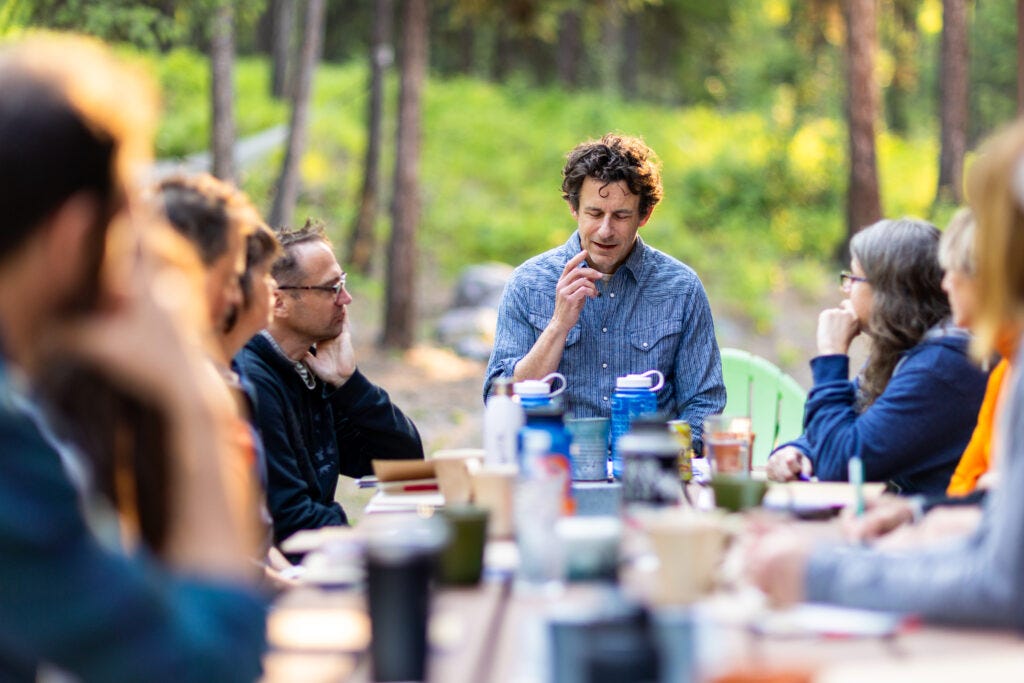
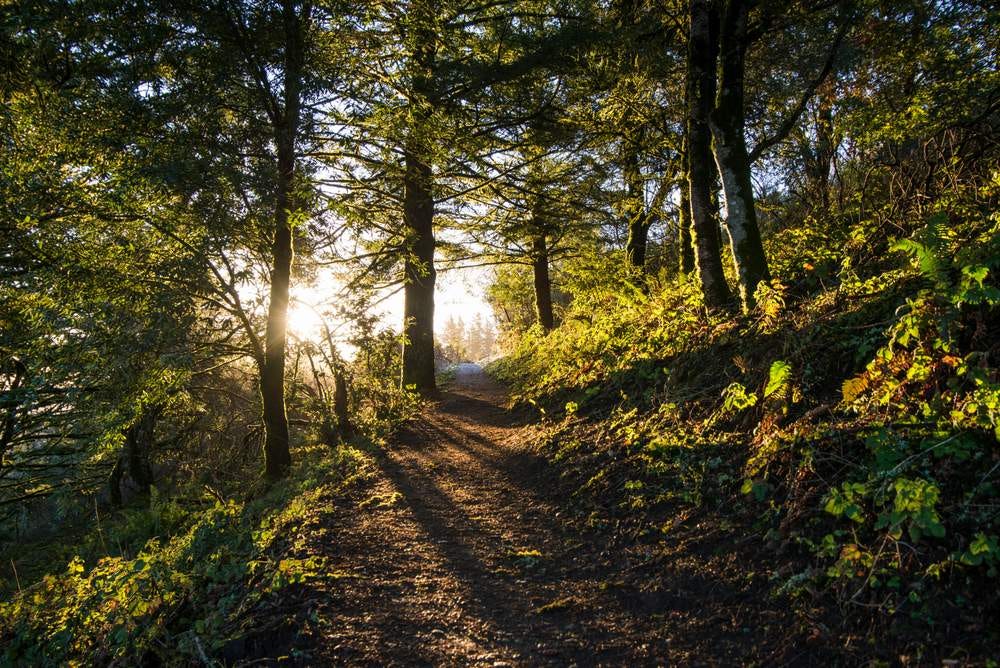
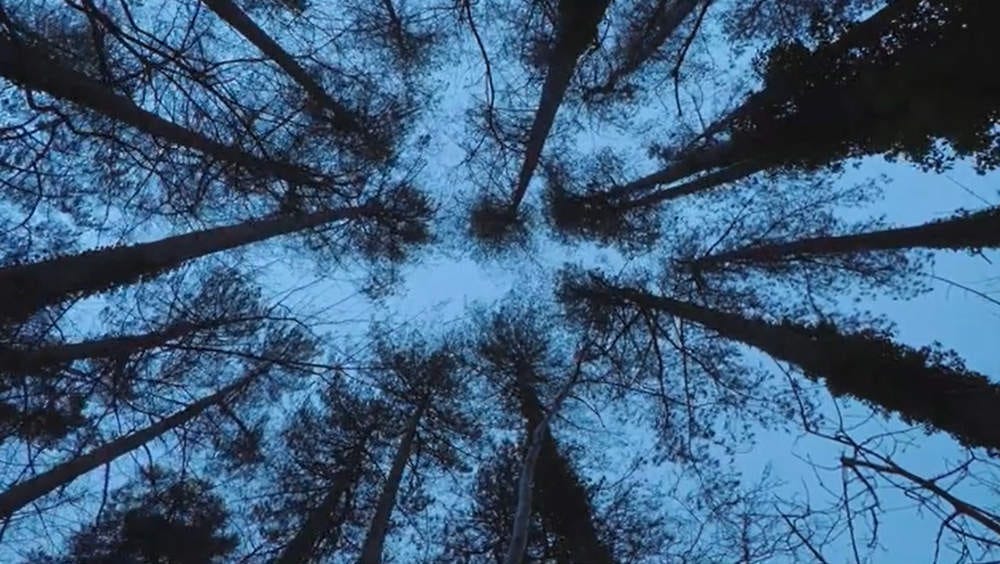
Hello! This is Everything Is Amazing, a newsletter about scientific wonders, gobsmacked awe and - beginning today - the benefits of being outdoors a bit more than usual. Someone who can definitely help you do the latter is the bloke at the end of this table:
That’s Brendan Leonard, who is heading a writing and trail running course (that’s one course where you get to do both things) this June, from the 7th to the 12th, in Montana. Brendan is such a terrific writer, so if you’re wanting to learn from the best and enjoy the many benefits of getting a bit of an outdoorsy sweat on, go grab your place before they’re gone. In Brendan’s words:
On the other side of the Atlantic…
It’s an early morning in 2016, and 29-year-old animator Stef Roberts is swinging from a tree. Well, two trees, actually: a single sturdy oak (which was easy to fling his ridgeline around when he set up his hammock) and a hazel (trickier, being an upward-explosion of thin branches converging at ground level). He’s been here all night, in a wood just outside Cambridge - but now it’s time to leave and head to work. Throwing his legs over the side, he pulls his rucksack over from where it’s been hanging, changes from pyjamas to street clothes, unties the boots dangling an arm’s length away and drags them on… His tarp remains rock-steady. If he’d tied it onto the same ridgeline as his hammock, all this movement would have sagged and crumpled the tarp down onto his head - but when Stef assembled his “bedroom” the night before, he used a separate rope for each. Of course he did. It’s been over 2 years since he started sleeping in the woods. It’s become second nature. The fire he (expertly) lit the night before is still warm, so he leaves it for last. The ridgelines are quick-release, so it’s only a five-minute job to stuff everything into his rucksack. Then it’s back to the fire: he scatters the cooling ashes in a widening circle with the toe of his boot, kicking cool earth over them to make sure they’re fully out, then hiding the scar with a scatter of twigs. A final tidy-up, and he looks back:
This is “Leave No Trace”, the unofficial mantra of the wild-camper (as outlined by Alpkit here). It’d also help him plead his case if he was caught - because what Stef is doing is technically illegal, even though thousands of English wild campers do it every year. (Only in one place in England, where less than 1% of the population own more than 50% of the land, is it legal to wild-camp - on Dartmoor, a national park in southwest England. In recent years, landowners Alexander and Diana Darwall tried to have this overturned. The British Supreme Court heard their case - and then unanimously rejected it in the middle of last year, opening the door to similar challenges to landowners in the future.) As Stef walks to where he parked his 2002 Subaru Forester, he chats away to the camera on the end of his selfie-stick:
He goes on to identify and scientifically name eleven other species of tree. This is important to him for two reasons. Every night he tries to pick a different place to sleep, and since he’s never been to this particular wood before, knowing these tree types makes him feel at home (in an expansive, geographically diffused way that us house-dwellers might find a bit confusing). It also reminds him of how reductive our nature labels can be:
This is where I had to hit pause on Stef’s YouTube video on the whole experience. I’ve slept in more than a dozen woods over the last decade (and under the odd bridge), part-inspired by the example set by journalist Erin Berger here. Has it made me an expert on trees, right down to their fancy Latin names? It has not, dammit. Is this just a quantity, frequency thing? By my calculation, Stef has slept outside maybe 500 times now (probably more, beyond these two years of solidly dedicating himself to it), so at some point, did his curiosity cross a tipping-point and he started absorbing all this stuff without really trying? Is that my problem - I just haven’t slept outdoors enough yet? That feels as daft as calling trees “trees”. Curiosity isn’t that passive. Stef wants to learn about trees, and no doubt the time he’s spent unconscious in the middle of them has helped, but it’s still a decision on his part - and unfortunately, on mine too. For a multitude of reasons (for example, “sleepless exhaustion due to freaking out at every tiny sound I hear in the pitch darkness for hours on end”), I just didn’t make the effort like Stef did. More fool me. (However, I can choose to do so in the future! Challenge accepted.)
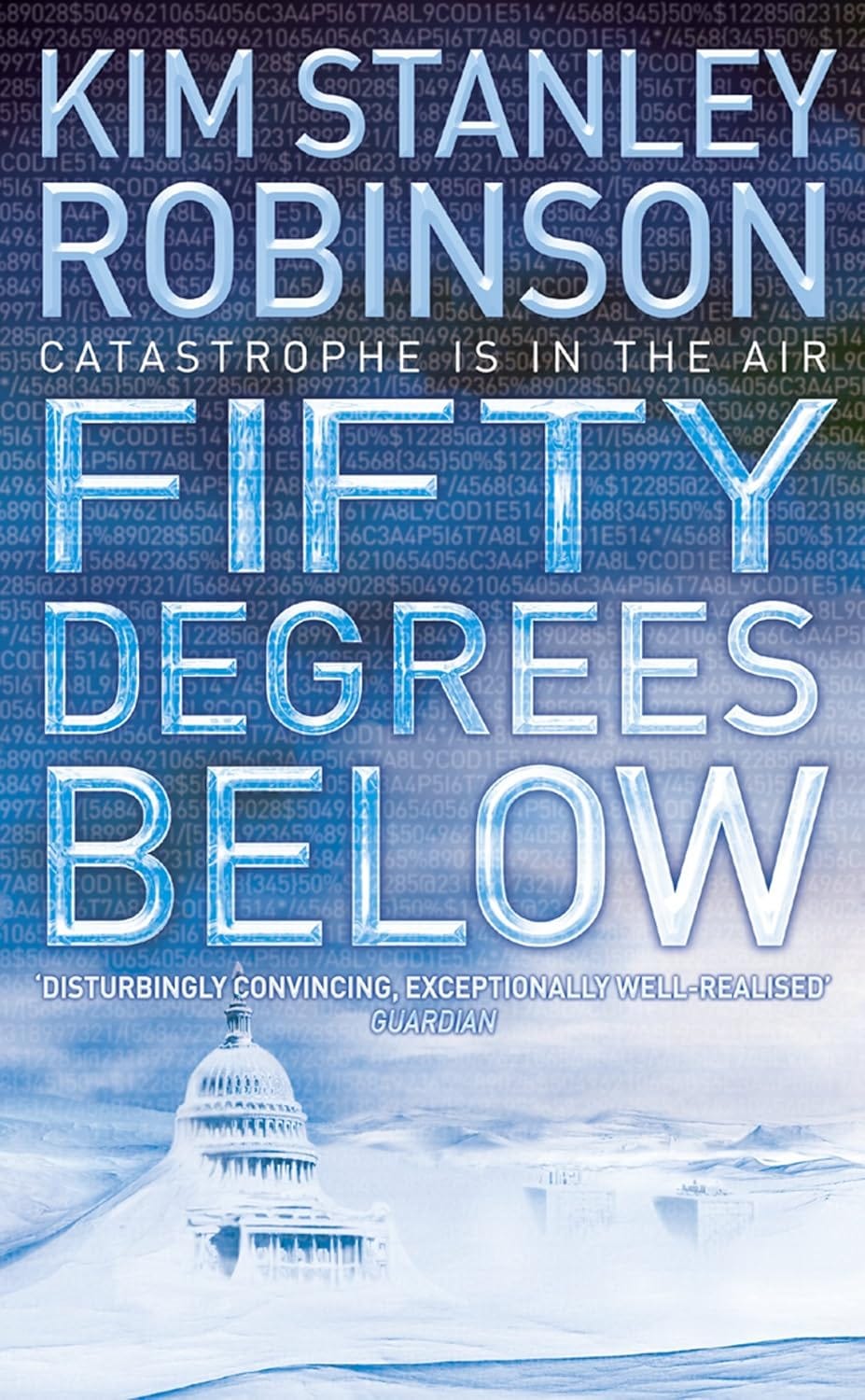
In Kim Stanley Robinson’s Fifty Degrees Below, biomathematician Frank Vanderwal decides to start sleeping outdoors. There are good practical reasons for this (or at least they feel good enough to him). He’s in Washington D.C., which has just suffered catastrophic storm flooding due to dramatically accelerating climate change. Rental prices have skyrocketed as a result, and after coming to the end of a homestay for a returning friend, he can’t find anywhere new to live. Hunting for affordable apartments is exhausting and demoralising. The whole thing is becoming so tiresome. Surely there must be an alternative? Frank decides it’s time for a new experiment in living outdoors - not to roll back the clock to a fully palaeolithic lifestyle, but to use modern materials (like his mountaineering gear) to make his nights bearable. Bedtime arrangements? He tries sleeping in his parked car, which proves to be awful (too uncomfortable, too visible, too transgressive in that way that attracts questions or challenges). Then he swaps his car for a van, and shoves a single mattress in the back of it. Much better. And wow - he could now sleep anywhere that has a road. The whole city is his bedroom! What about staying clean? Simple - he joins a gym to use the showers. Clothes? Launderette. Piece of cake. Food? Oh, luxury! Now he can park near any restaurant, supermarket or street-food vendor he chooses. His day-job is working at the National Science Foundation (a real-world government department currently doing terrific work under an administration that’s partly trying to gut it), trying to halt or even reverse the global effects of rapid climate collapse - and in his spare time, he joins the Feral Observation Group, tracking the animals of the local zoo that were freed during the storm. Eventually, he’ll find he’s spending so much time in and around Rock Creek Park that he decides to build a treehouse for himself in it, and… Well, that’s as far as I’ve got in my read-through of the novel. I know [spoilers!] that later in the book a deep freeze is coming - hence its title - and I know it will drive Frank indoors once more. But the parallels here with what Stef Roberts did in 2016 are fascinating. Like Frank, Stef spent his days mostly inside, self-employedly working out of cafés in and around Bristol. He used a launderette to…well, launder things. Like Frank, he chose good-quality modern equipment to use for his nights out under the forest canopy (and used his car as a mobile storage locker, as well as his main mode of transport). He kept himself clean in all sorts of ways, including swimming in lakes - and he brought food to his campsite to cook on the fire, never anything complicated: a boiled carrot and roasted courgette chopped into a pan of cooked rice, or a precooked salmon fillet scattered over pasta. Just the tasty, tasty basics. So - do you see Stef as a pioneering modern adventurer, or a pointlessly reckless young fool? (No offence intended, Stef.) 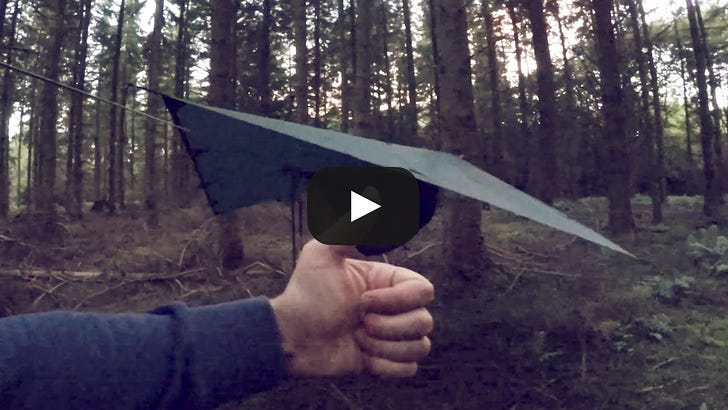 I’m hardly on the fence on this topic. I love sleeping outdoors, even though I’m not terribly good at it. (I am unfortunately still this idiot.) But I can easily imagine the arguments against wild camping being dominated by the tyranny of usefulness - questions like “but but but what’s the point when you can be warm and dry and so much safer indoors?” or just “for god’s sake, why? Is the state of the world right now not enough for your nervous system?” In its defence - well, it’s good for you to be outdoors so much! Or it feels like it is. Or it feels like it might be, which is something approaching a decent reason to give it a go, if you’re feeling careful/brave/stupid enough - as long as you don’t forget these are feelings you’re having, rather than facts. In this way, wild camping edges dangerously close to the category of a “nature cure” - which, in the wrong hands, can become as commercially exploitable as any other predatory fad built upon the fumes of dodgy science. Even if our intentions are well-meant, we risk turning the Great Outdoors into just another natural resource for us to strip-mine, as Polly Atkin explains here:
(Hat-tip to Kizzia for making me aware of her work!) There’s also the moral ick of it. There you are, super-privileged to be doing a thing for kicks that far too many people in the world are doing because they have to. It can feel insensitive - but maybe not feeling that internal conflict while you do it is the greater danger to our humanity? (Also - let’s hear it for solar-blanket-inventing teenagers!) But it’s also a fun thing to do, and I’m a big fan of how utterly useless that fun can be, especially as an antidote to the seriousness of professional wellmongers. Okay, I know hanging from a tree or huddling in a sack in the dark may not sound especially joyous - perhaps because for many people it absolutely isn’t, being that particular flavour of fun that’s demanding, uncomfortable and alarmingly horrible at the time. Type 2 fun is like whisky: you need to return to it later, preferably after a few decades, for all that flavour to have come out. (But it can be great fun, under the right circumstances and with the right precautions taken and attitude donned like emotional armour, etc. etc. disclaimers in abundance. Honest, guv.)
This season of Everything Is Amazing, I’m looking at all this with as much scepticism as my outdoors-besotted bias will allow (as I previously explained here). I know that all this “nature cure” stuff is a bit out of control - but I’ve read The Nature Fix by Florence Williams, which tackles the subject with commendable scientific rigour, so I know there’s certainly something in it. I know in this era of long waits for doctor’s appointments and nightmarish health insurance costs, it’s enormously exciting to consider there’s a free - or near-as-dammit free - method of improving our health. A way that’s fun! But isn’t that also selfish and short-sightedly extractive? A justification for another kind of land grab for our own benefit, instead of an acknowledgement of our responsibility as stewards of the world we live in? And hey, in Antonia Malchik’s words - doesn’t the fox own herself? I know that there’s little that can lift our spirits like a walk outside on a sunny day when you can basically see forever (there’s something about refocusing your eyes on the very-far-away after too much squinting at screens that can be so relaxing, and not just for your eyes). But I also know the very end of the re-imagined Battlestar Galactica, where they all decided to “abandon all their technology” and reboot civilization with a “clean slate” was…oh come on now. Please. Guys.  (I would not have asked Stef Roberts to abandon his rainproof tarp and thermal sleeping bag liner in the dead of the British winter, any more than the fictional Frank Vanderwal should have frozen to death in his treehouse.) If hard-line digital Waldenponding disconnects us in the wrong ways as well as the right ones, isn’t it safe to assume the real, downed-modern-tools version will tend to be fraught with similar issues? (And is Walden really the right standard for us to aspire towards? Kathryn’s Schulz’s yikes-inducing 2015 essay in the New Yorker suggests otherwise [archive link] - with a lively rebuttal in The Atlantic by Jedediah Britton-Purdy here [archive link].) There’s a lot here! Some of it may even be life-changi….oh dear, look at that, it’s so easy to fall into this stuff. Let’s just say it should be interesting, and if any benefit to your health results of trying anything out for yourself, that’s entirely your win and not mine. (“The same applies in the other direction.” - Mike’s lawyer.)
On the 13th September 2018, Stef Roberts announced on Instagram that after 4 years, 4 months and 13 days, his forest-dwelling life was coming to an end. It wouldn’t happen immediately. He’d still spend a few nights out here and there, during a transition period where he’d gradually move his nights back indoors. But he knew a lot had to change:
The outdoors is great and all, but maybe there are more important things in life. Images: Brendan Leonard; Marcus Byrne; Mark Timberlake; Ethan Dow; Stef Roberts.
|