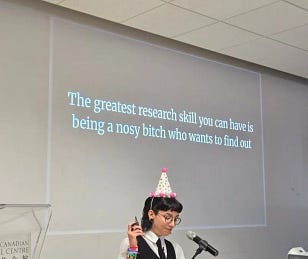
One of my core beliefs is that good thinking take time. That most people mistake for genius what is really just time. Today, we’re sharing an essay by longtime Sublime member and cultural strategist Alexi Gunner on resisting algorithmic sameness, excavating your own perspective, and treating research as a form of pattern disruption. While his work lives in the world of culture and trends, the ideas in this piece apply to anyone trying to think clearly about anything today.  It’s also a love letter to a slower way of thinking and to using Sublime <3. If you’ve ever felt rushed to have an opinion before you were ready, this is for you. Enjoy ;) Research as a form of pattern disruptionThere are more trend forecasters, futurists and TikTok oracles than ever. So why does our idea of the future still feel so devoid of nuance, inspiration and possibility?By Alexi Gunner • JAN 15, 2026 The industry of cultural futuregazing, once a niche subset of ‘coolhunters’ in the 90s, who began tracking street-born trends for brands, has evolved into a sprawling industry. This year alone, 135+ trend reports were published by tech companies, agencies and consultancies. Today, anyone with a TikTok account or Substack and a penchant for digital decoding can become a trend forecaster. Some refer to it as a whole new class of content creators - what fashion search engine Lyst has coined ‘vibe analysts’: “info-influencers acting as digital spirit guides to the next big thing”. Yet, despite this abundance of enthusiasm for cultural research, it often feels like it’s easier than ever to slip into the gravity well of banality. Cookie-cutter essays optimized for algorithmic engagement. Hot takes stripped of depth. Fleeting fads interpreted as extreme, paradigm-shifting hyperbole. We resort to dramatic binaries, either painting the future through the lens of stressful dystopias and exclusionary utopias. The limitation of our vision is not due to insufficient data. Instead, what I think we’re missing is a sense of imagination, creativity, and genuine curiosity. Without these elements, the act of research itself has lost its potency, our findings and interpretations reduced to a shallow performance, where the same ideas are recycled and repackaged in an endless feedback loop. In this essay, written in partnership with Sublime, my main personal knowledge management tool, I’ll share how I approach research as a form of pattern disruption, an intentional practice for breaking free from the hall of mirrors that traps so much of today’s trend forecasting. I’ll walk through how I use Sublime to collect, connect and create meaning from information in ways that resist the common shortfalls: confirmation bias, surface-level analysis, and the pressure for immediate answers. It’s an approach that embraces discomfort rather than absolute certainty, curiosity rather than conclusions. Fuelled by a desire to explore the unknown, to go down deeper rabbit holes, I believe the greatest research skill you can have is, indeed, “being a nosy b***h who wants to find out“.
Tuning in to weird signalsIn the world of trend research, we are traditionally taught to be on the lookout for ‘weak signals’ - small, low-frequency indicators that hint at a potential shift in culture. And while scanning for these weak signals is a fundamental part of the process, it’s easy to get stuck in a pattern of only noticing evidence that confirms our preconceived notions about the world. We develop tunnel vision, unconsciously conforming to the ideas and beliefs that dominate the zeitgeist of any given moment. Instead, what I have trained myself to look for, more specifically, are ‘weird’ signals. Weird signals are behaviours and phenomena that feel strange or out of place. But importantly, they also tend to hint at unanticipated future cultural upheavals. As cultural futurist Jasmine Bina explains: “weird signals usually give us a glimpse into the future we can’t see yet. Every major cultural shift that changed our lives once started as a small anomaly in the system.” It’s easy to avoid these uncomfortable anomalies, because they create cognitive dissonance. But by embracing discomfort and attuning ourselves to weird signals, we can begin to spot unexpected and alternative realities that are vastly different from our current day. In William Gibson’s 2003 cyberpunk novel Pattern Recognition, the protagonist Cayce Pollard, a coolhunter and creative consultant, utilises her body’s visceral reaction to the world around her to detect irregularities and deviations. Like Pollard, spotting weird signals requires us to tune into our nervous system to cut through the noise to find glitches in the matrix, embracing the discomfort that comes with stumbling across the peculiar. Glitches in the system, like punk birding groups, and luddite teenagers promoting self-liberation from social media and technology. ‘Or the rise of ‘homebars’ across China, designed to replicate the experience of living together with friends, and the emergence of study raves in Australia, helping students to focus through high-energy beats. Weird signals can take the form of almost anything - snippets from articles and essays, images, social media content, a conversation on a podcast. Sometimes, it’s a strange meme that hints at an emerging shift in our collective mood, societal worries, and desires. To spot weird signals, you need to go down rabbit holes. Follow your intuition. And remember, pursuing rabbit holes is not always an act of procrastination. Sometimes, it’s simply your mind telling you to follow your curiosity. Weirdness can present itself at any given moment, through any medium. When I see something, I instantly save it with the Sublime web extension. Or I use the Podcast Magic app to capture soundbites from interviews and podcasts. Like an eager digital forager, I highlight, screengrab, upload, and save with reckless abandon whenever strangeness presents itself. Avoid algorithmic rabbit holes, because they will dull your exposure to weird signals and trap you in a bubble. To spot anomalies, you need to escape your Instagram feed and FYP page. Don’t let social media platforms shape how you see the world! A lot of work goes into manually curating my information feed. Read widely, and actively. Follow interesting researchers who publish on Substack. Lurk in the dark forest of Discord servers, where fringe conversations thrive. When I’m foraging for signals, I don’t worry too much about organisation or classification. With Sublime, unlike other PKMs, you don’t have to incessantly tag it to find it later. With a solid AI search engine, it’s easy to find things you’ve previously saved. Instead of tags, I’ll intuitively create a collection for the signal that frames an initial hunch about whatever you’ve captured (or save it to an existing collection if an instant connection presents itself in your mind). Spotting non-obvious connections
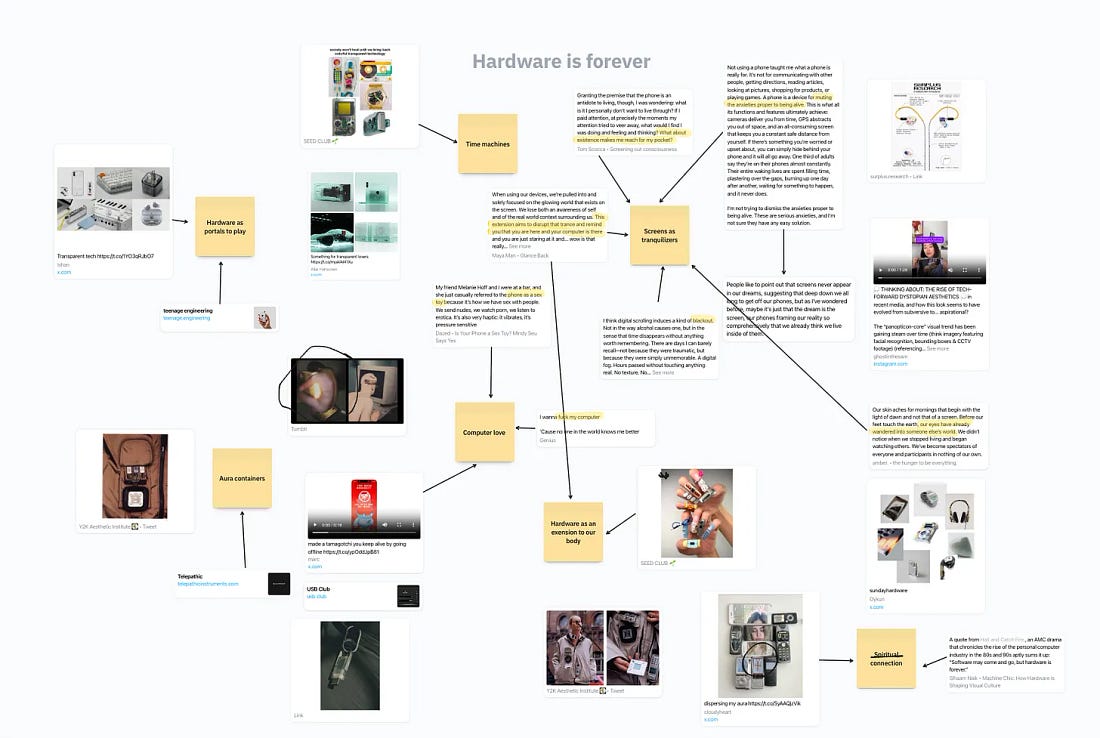
At regular intervals, I’ll return to my research on Sublime, to sort, reflect and connect. After all, collecting without connecting is just hoarding—a library full of signals collecting digital dust. Traditionally, I’d use a variety of pre-defined tags to start to make sense of the signals. What sectors are involved? Psychographics? Relevant markets? Maturity level? Underlying need states? I’ve often felt that this approach to organising research tends to guide you towards a more linear, stale way of making sense of trends. It funnels you towards drawing connections between similar signals, across interlocked domains in culture. Like uncovering a trend that encompasses food, drink and hospitality. Or identifying a new, emerging tech sector. Not wrong, or inaccurate. But perhaps a little obvious? And with so much homogeneous thinking out there on the future of culture, obvious holds little value. With Sublime, instead of traditional tagging, I’ll curate research by specific questions or theses. Perhaps it’s a provocation, or a question I’m aiming to explore, or a shower thought about the future of culture. But it’s always based on an intention. Something specific I’m personally intrigued by, or niggling problem I’m trying to explore for a client. What if we reintroduced more friction into society? Resolving the loneliness epidemic through third spaces. What comes after the hipster? The death of mystery. Arranging research into these broader, more abstract themes encourages me to go non-linear, embracing expansive, freeform sense-making. Suddenly, it’s much easier to connect dots between vastly different areas of life to explore the defined intention. It invites me to find connections across a multitude of subcultures and demographics. Across both mainstream discourse and the experimental fringes of society. From highbrow and lowbrow culture (and everything in between). There are also ways to tap into the wisdom of the crowd to find the non-obvious. ‘Save one idea, discover 100 related ones’ - Sublime’s discovery engine that shows you related cards in the Sublime database - helps me to uncover new ideas and quirky tangents related to my collections. Recently, a collection I’d built around the death and rebirth of nightlife unearthed a post exploring the rise of fluid, fragmented, and decentralized clubbing communities beyond the massive entertainment venues that have otherwise come to dominate nightlife worldwide. An idea was hand-saved by a real person, which sent me down an unexpected but wholly relevant rabbit hole. Once I’ve gathered these disparate signals, and go from collecting to connecting, I need to work spatially, using mind-mapping tools. Usually, this is Miro or Figma, but recently it’s mostly happening in Sublime’s Canvas function, where I can automatically create boards that link to my collections. This is what makes Sublime unique compared to other typical bookmarking tools - there’s a seamless bridge between curating information and creating meaning, where I can automatically create boards from my collections, giving me space to draw arrows between information, scribble tangents, and cluster research. This way, I can make far more interesting connections and create coherent meaning from all the noise. It syncs up new cards added to the collection, so you can keep coming back to the board as the research grows.
Machines for breadth, human intuition for depthSean Monahan, co-founder of K-Hole and writer of the 8Ball newsletter, recently argued that, with the advent of AI, the human trend forecaster will become obsolete. I disagree. What I think will happen instead is that LLMs will raise the standards for our trend research. Machine and human sense-making operating in tandem, expanding what’s possible and helping us break free from our filter bubbles. AI offers breadth - it aids me in cross-referencing unprecedented amounts of disparate information sources and millions of data points. With Sublime’s ‘Chat’ function, I’ll export particularly big collections to my LLM to kickstart the sense-making process, or when I feel overwhelmed by the sheer amount of research it contains. Meanwhile, my own cultural intuition offers depth - it helps me to identify emotional nuance, uncovering unexpected angles to a trend. What’s the opposing force that exists in tension? What’s the uncomfortable angle that needs to be acknowledged? How would an outsider see this differently? What’s the destructive or distressing dimension? Zoe Scaman calls this new breed of centaur analyst the ‘synthesized strategist’: “They wield AI like a sixth sense while maintaining razor-sharp human judgment. Most importantly, they’re masters of synthesis – weaving together insights from multiple domains, perspectives, and tools to forge clarity from complexity and light new paths forward.” Resisting immediacy
“In an age of speed, I began to think, nothing could be more invigorating than going slow. In an age of distraction, nothing can feel more luxurious than paying attention. And in an age of constant movement, nothing is more urgent than sitting still.” In the art of stillness, Pico Iyer argued that in our madly accelerating world, there’s never been a greater need to slow down. There is a similar urgency for stillness in cultural research. We are living through an era where trend cycles move at hyper-speed, compressed into 24-hour cycles. Every day, there’s a new shiny fad, a new viral moment, flocks of forecasters and oracles eager to crown them with a new catchy title, in an attempt to drive engagement and visibility in the feed. Yet, these isolated spikes flatten the story and miss deeper patterns. As cultural theorist Matt Klein astutely points out, we are “conflating trends with what’s trending”. The fact is, culture moves slowly. Sometimes, painfully so. What starts as an anomaly gradually accumulates into a pattern, eventually entering the mainstream zeitgeist itself. It’s these slower-moving undercurrents I’m interested in. The subtle drifts beneath the media hype cycle that fundamentally shape how we behave, connect, consume, and express ourselves. These currents only become visible over time, as signals accumulate and the ground beneath our feet shifts, almost imperceptibly. A movement challenging people to go offline forever becomes part of a bigger story about the great rewilding. ‘Scream clubs’, at first seen as a quirky anomaly, shape up to become one of the many ways we fulfil a desire for collective catharsis. Purposefully dirty makeup, initially a temporary beauty fad, begins to tell a broader story about our exhaustion with the pressures of modern life. In strategist Nikita Walia’s critique of TikTok oracles, she argues that cultural commentary today favours brevity, at the cost of depth, algorithmic performance over exploration, virality over rigor. All of which prioritize speed and instant output: “rather than a participatory culture that deepens understanding, we have one that accelerates interpretation at the expense of complexity, where discourse is less about discovery and more about domination.” Amid this competition for algorithmic domination, where there is pressure to constantly decode and make meaning from the 24/7 internet hamster wheel, I have to remind myself to resist this manufactured immediacy. A PKM like Sublime helps me slow down and take a far more iterative, contemplative approach to cultural research by encouraging me to treat my collections as digital gardens.
When you think of your research as part of a digital garden, it’s less about solidifying and publishing thoughts across my Substack and client work as part of a linear process, in the hope of being the first to classify a cultural phenomenon. Instead, it becomes something far more slow, fluid and organic, where broader trends and undercurrents are continuously revised, and nurtured as the proof and signals grow over time. Deeper, more nuanced layers begin to reveal themselves, and a broader story takes shape. My collections will evolve over time, as they grow. Many of them are now several years in the making, taking on new shapes and meaning. I also acknowledge that they may go through periods of rot and weeds, during which I must choose to actively prune irrelevant signals or change the direction of the collection entirely. I put time in my calendar once a month to tend to my gardens. In contrast to the usual frenzy of client work, the gardening feels mindful, quiet, reflective - a digital equivalent to touching grass. Excavating your own perspectiveThere’s a quote saved in my Sublime library that I think about all the time: “research is the sacred ritual of excavating your own perspective”. Ultimately, this is the end goal of my cultural research. It’s chipping away at all the chaos, uncertainty, and mystery, tuning into weird signals, making non-obvious and expansive connections across a multitude of domains. It’s about embracing a slower sense of reflection, until a path forward begins to illuminate itself. A vision of a new potential future that feels vastly different than our current reality. Not shaped by the echo chambers of the internet, but one that has taken shape through my own process of self-discovery.
|