You’re reading Read Max, a twice-weekly newsletter that tries to explain the future to normal people. Read Max is supported entirely by paying subscribers. If you like it, find it useful, and want to support its mission, please upgrade to a paid subscription! Greetings from Read Max HQ! Today’s newsletter is about commenters in the Trump administration. A reminder: This newsletter is my full-time job. Everything you read here is a product of a lot of thinking, reading, reporting, writing, more thinking, procrastination, self-contempt, etc. If you appreciate it--if you find the writing helpful, informative, entertaining, “a good enough way to pass the time”--consider rewarding that work with a paid subscription. Think of it this way: Would you buy me a beer in exchange for eight newsletters a month? Well, at $5/month and $50/year, that’s almost exactly what you’re doing, though I might spend the money on something besides beer, like “childcare.”
Way back in September, in a piece on F.C.C. Chair Brendan Carr pressuring ABC to take Jimmy Kimmel off the air--remember that?--Semafor’s Ben Smith dropped a bit of gossip that has been haunting me ever since:
The Gawker comments section! We are ruled, as it turned out, not only by ghouls, fascists, sociopaths, salesmen, influencers, mediocrities, and abusers, but by something stranger and potentially worse: Gawker commenters. This shouldn’t come as a shock. As Smith suggests, this is an administration of posters, a genus within which “commenters” comprise one particularly fascinating species. I have written perhaps too much about the extent to which Donald Trump and Elon Musk resemble well-worn message-board poster archetypes, but we can also say that many members of the Trump administration are also identifiable as commenters, in spirit if not in actuality. Trump himself, e.g., is an obvious NYPost.com commenter; J.D. Vance, as many have pointed out, a Redditor; Musk a familiar Slashdot--or, worse, Fark--type; Steven Miller, almost too obviously, a VDare guy. But who, in this administration, would have been a Gawker commenter? I ask out of curiosity, rather than surprise. Gawker now carries with it a somewhat questionable reputation as a redoubt of 2010s wokeness, but I worked there during its wokest era and even then we hosted many commenters--both irritating but ultimately manageable regulars and quickly banned drive-by trolls--who were, in retrospect, easily identifiable as “future Trump supporters.” Especially in Gawker’s early years as a relatively narrowly scoped media gossip blog, the most devoted readers were well-off professionals who spent lots of time at their desks and needed websites to refresh: People in media and publishing, obviously, but also plenty of “creatives,” tech and finance workers, and, especially, lawyers. In the 2000s, these people were not, necessarily, liberal; they also contained a much higher proportion of Gen Xers, and we all know how they turned out. But even beyond the demographic specifics of early Gawker, to be a regular commenter anywhere¹ is to constantly put yourself in a subject position all but guaranteed to develop the kind of resentment that powers Trumpist politics: Your voice is (literally) suppressed, made subordinate, often hidden; your intelligence and expertise receives a fraction of the attention of the glib P.M.C. blogger you’re responding to, whose attention and approval you both scorn and desire. Among the altogether too many “unfortunate and stressful experiences I had at Gawker that in retrospect prefigured the political dynamics of the Trump era” was the Gawker Hack, in which chat logs between Gawker writers (among other proprietary information) were leaked to the press, including one in which Richard Lawson (now writing the great Premiere Party newsletter) referred to commenters as “peasants.” Any sane person who has ever read ten words of Richard’s writing could immediately and easily identify this as a joke--but many Gawker commenters, paranoid about their own position relative to the writers, neurotic about their emotional investment in a site that mostly ignored their contributions, took real and sustained offense. For years afterward,² commenters would sometimes refer back to the gag with geniune hurt, seemingly imagining themselves as the Forgotten Men of the Gawker empire (such as it was), discarded and disdained by the haughty bloggers. That was commenter resentment. Smith mentions that many Trump administration staffers and appointees are “people whose defining experiences in public life involved being silenced by social platforms.” I think just as important to the actual silencing in the self-conception of many Trump ghouls is the sense that some other, less deserving voice was being heard or elevated. There are obvious resonances here with the structure of political feeling that characterizes Trump voters in general. But it’s also basically how angry regular commenters feel about the blogs to which, for whatever reason, they’ve shackled themselves. I suppose my point is that one way of thinking about the Trump era is as: The commenters are running the show now! Anyway, at the time of Smith’s reporting I made some half-hearted attempts to figure out the identity of the Gawker-comments alumnus Trump appointee, but there were no particularly obvious candidates. Basically any lawyer is a plausible former Gawker commenter, and basically any Trump appointee is plausibly annoying enough to have earned a ban. But I should have realized that a scorned Gawker commenter would never be able to keep it to herself. The State Department’s undersecretary for public diplomacy, Sarah B. Rogers, outed herself this week in a Semafor podcast³ as the owner of four separate Gawker commenting accounts, which (she tells Smith and co-host Max Tani) were created as a preemptive defensive measure in case Gawker ever wrote about her wedding⁴:
Rogers, whom the English press have taken to calling “Trump’s free speech tsar,” has been charged with advocating for loosened free-speech laws as part of the Trump administration’s war on Europe, especially around American social platforms. Her background is in speech law, which seems about right: Someone who was a libertarian lawyer in 2009 is pretty likely to have had a Gawker commenting account at the time, and to be a Trump supporter now. But what, exactly, got her banned? (Remember, in the original item, Smith writes that for his source “a radicalizing experience was being booted out of the Gawker comments section.”) Smith asks if she was “tossed off Gawker for being too right-wing?” and then the conversation gets sidetracked; when they return, Rogers is cagy, and her interlocutors never get a straight answer:
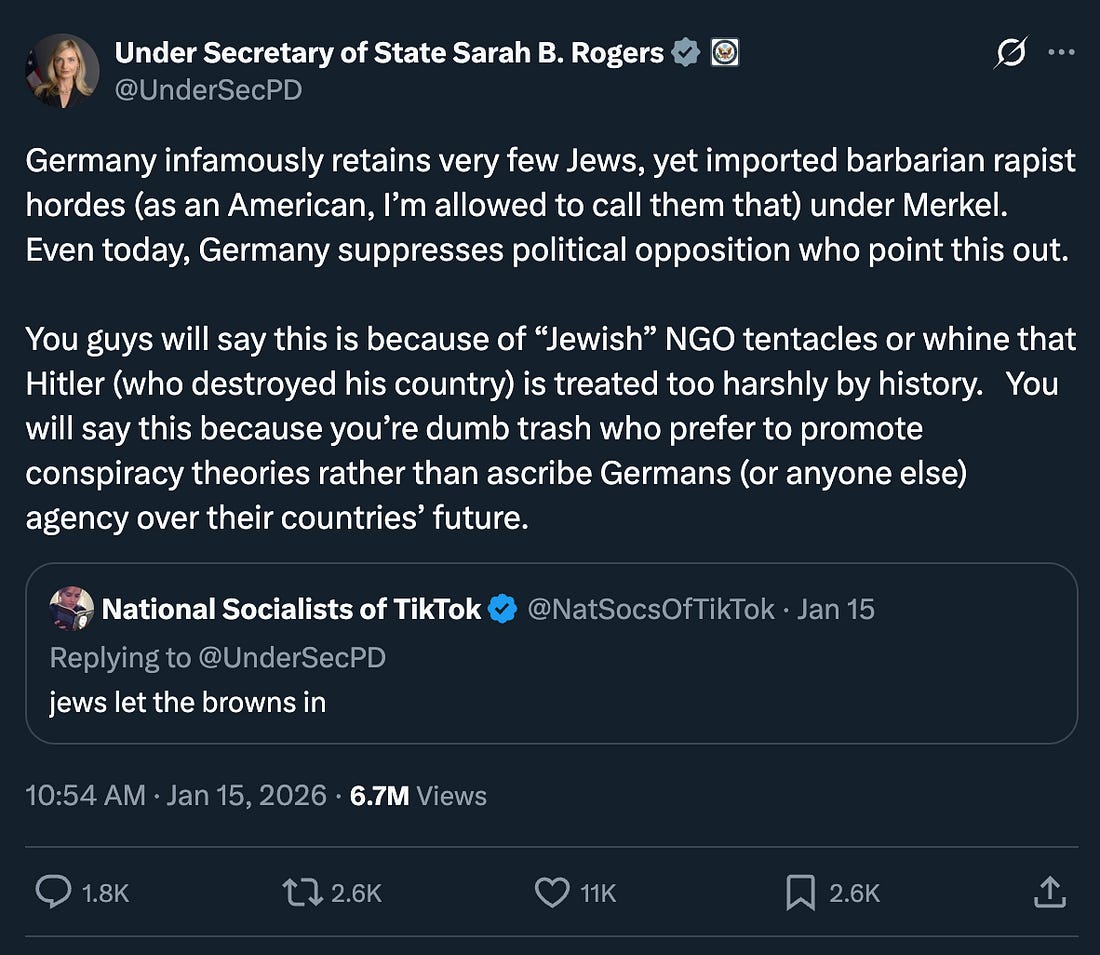
Okay, but what specifically got her banned? And, for that matter, what does “not racist in the sense that is morally pejorative” mean?! Sadly, the Gawker comments were wiped when the site was sold and its archives were moved, so we may never know. We have, at least, Rogers’ official State Department account, where you can find her recent response to the Twitter account “National Socialists of TikTok”:
Ah, yeah, that sounds like a Gawker commenter who’d get bounced to the grays. 1 Present company excluded, of course: I love you guys. 2 Longtime commenters especially tend to develop a thwarted sense of ownership and blinkered sense of nostalgia about the sites on which they comment: A “Make Gawker Great Again” campaign would have really killed back in 2012. 3 I mean, I’m assuming that Rogers was Smith’s source for the September piece. It’s possible that there are two Trump appointees who were radicalized in the Gawker comments section. 4 This is obviously an insane thing to have done but is not even in the top ten most insane things that either a Trump administration appointee or a Gawker commenter has ever done. You're currently a free subscriber to Read Max. For the full experience, upgrade your subscription.
|